
Courier vs post: which is right for you?
By Rubi Rodriguez
Published on October 19, 2026
In short
Courier vs post (or courier vs mail, as many people search it) isn’t a contest with one permanent winner. Canada Post offers tracked and expedited services, and private couriers aren’t automatically faster or more expensive. The right choice depends on each shipment’s value, urgency, weight, destination and how much delivery visibility you need. That’s why comparing services shipment by shipment usually beats committing to a single carrier type.
Which shipping option is better for your needs?
Most businesses pick a shipping “side” early. Some default to Canada Post because it feels economical. Others send everything by courier because it feels safer. Both habits leave money, or service, on the table. Your customer doesn’t care whether a postal operator or a private courier delivered the box. They care that it showed up when you said it would, in one piece, with tracking that made sense. This guide breaks down the real differences between courier and postal shipping in Canada, and gives you a framework for choosing the right service for every order.
Key Takeaways
- Compare services, not carrier types. All four Canada Post domestic parcel services include tracking, and three come with an on-time guarantee.
- Postal shipping often makes sense for lightweight, non-urgent orders and for PO box, rural or remote addresses.
- Couriers often make sense for time-definite, higher-value or B2B shipments where proof of delivery matters.
- Five factors should decide each shipment: urgency, value, weight and dimensions, destination, and the visibility you need.
- A multi-carrier strategy lets you match each order to the best available service instead of forcing every shipment into one network.
Courier vs post (or mail): what’s the difference?
A postal service like Canada Post runs a national network built to reach almost every address in the country, from downtown condos to rural routes and PO boxes. On top of letter mail, it offers several parcel service levels. In Canada those are Priority, Xpresspost, Expedited Parcel and Regular Parcel.
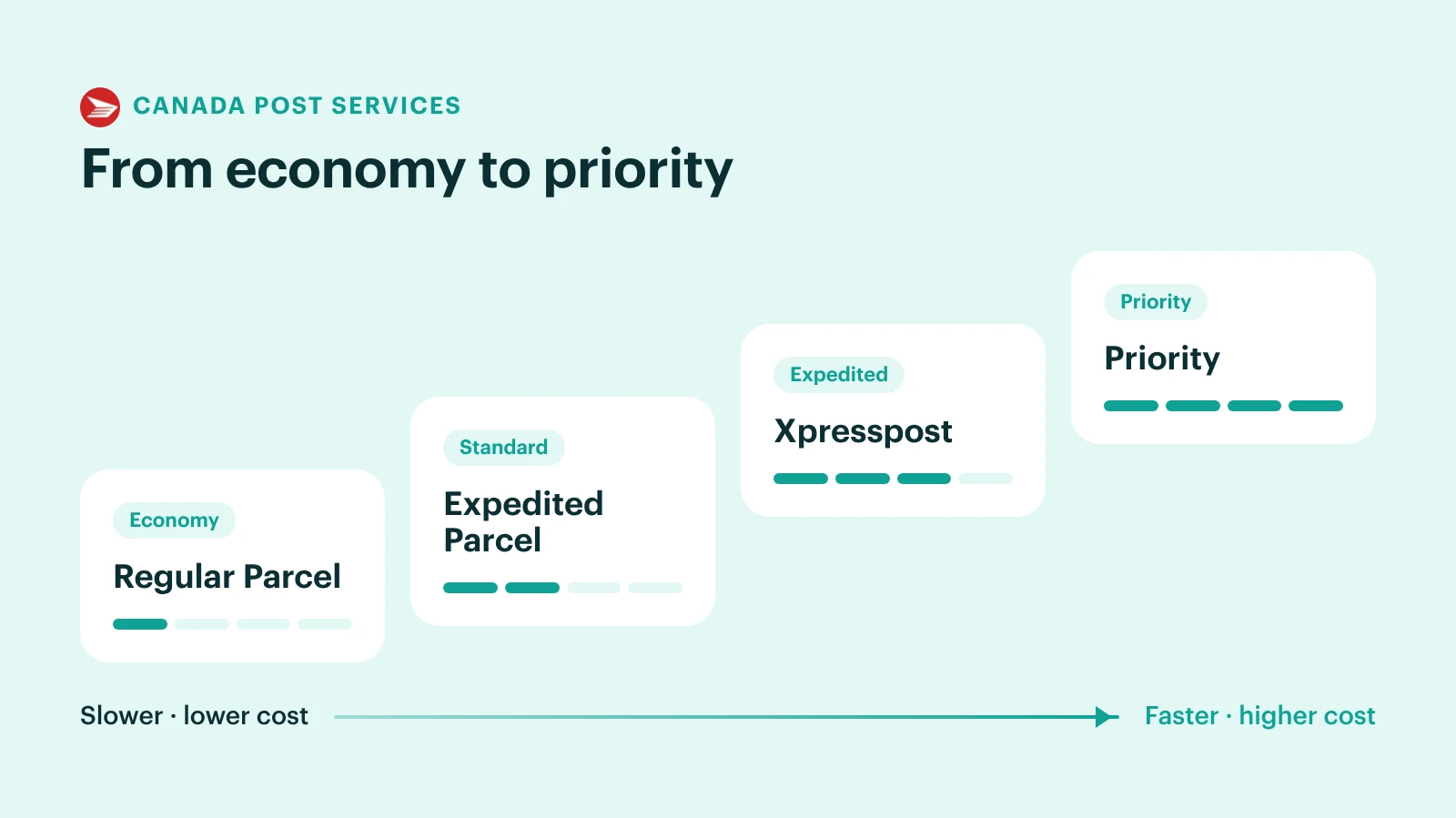
A private courier like Purolator, UPS, FedEx or DHL runs its own pickup, sortation and delivery network. Couriers also sell several service levels, from economical ground options to express and time-definite services.
The old shortcut of “post is slow, courier is fast” doesn’t hold up. According to Canada Post’s own service comparison, all four of its domestic parcel services include tracking and delivery confirmation. Between most major urban centres, Priority delivers next business day locally, regionally and nationally. Xpresspost is next day locally and regionally, and 2 business days nationally (Canada Post). Meanwhile, a courier’s ground service can take several business days on a long lane. You have to compare service levels, not carrier categories.
There is no single best shipping option for every business order
The question “which is better?” only has an answer at the shipment level. The same business might ship a $15 accessory to a rural PO box on Tuesday and a $2,000 replacement part to a customer’s plant floor on Wednesday. No single service is the best fit for both.
Once you treat carrier type as a per-shipment decision instead of a company policy, the conversation shifts from “who do we ship with?” to “what does this order need?”
Courier vs post comparison table
| Factor | Postal service (e.g., Canada Post) | Private courier (e.g., Purolator, UPS, FedEx, DHL) |
|---|---|---|
| Total cost | Often competitive for lightweight parcels; volume contracts available | Often competitive for heavier or time-sensitive parcels, especially with negotiated rates; varies by lane and contract |
| Speed / delivery commitment | Ranges from economy to next-day (Priority); on-time guarantee on some services | Ranges from ground to express and time-definite; guarantees vary by service |
| Tracking and proof of delivery | Tracking included on domestic parcel services; signature available | Tracking standard; signature and proof of delivery options vary by service |
| Geographic coverage | National network, including many rural and remote addresses | Strong urban and commercial coverage; remote areas may carry surcharges or partner handoffs |
| PO boxes | Delivers to PO boxes where available | Generally requires a street address (Purolator states it does not deliver to PO boxes) |
| Pickup | Scheduled and on-demand pickup, fees depend on volume and service | Scheduled and on-demand pickup, terms vary by carrier and account |
| Weight and dimensions | Size and weight limits apply by service | Size and weight limits apply by service; oversize surcharges vary |
| Shipment value and protection | Included liability on some services; extra coverage available for a fee | Declared value / extra coverage available; terms vary |
| Cross-border | Hands off to the destination postal network (e.g., USPS) | Often stays within one network end to end, with brokerage options |
Features vary by carrier, service, lane and contract. Always check the specific service before you book.
When postal service can make more business sense
Lightweight or non-urgent shipments
For light orders where the customer chose economical shipping, a postal service is worth comparing first. Between most major urban centres, Canada Post publishes Expedited Parcel delivery standards of 1-2 business days locally, 1-4 regionally and 2-8 nationally, and Regular Parcel at 1-3 days locally, 3-6 regionally and 4-10 nationally (Canada Post). If that window matches the promise you made at checkout, paying for faster service may not change the customer experience. Our guide to standard shipping covers this trade-off in more detail.
Destinations where postal network coverage is an advantage
PO boxes are part of Canada Post’s network, and private couriers generally can’t reach them. Purolator, for example, states plainly that it does not deliver to PO boxes (Purolator). Postal service can also be a strong option for rural and remote residential addresses. Canada Post’s Xpresspost and Expedited Parcel also offer delivery to a post office, which can help customers who aren’t home during the day. Options still vary by service and destination, so check eligibility before you promise anything at checkout.
When a courier can make more business sense
Time-sensitive shipments and tighter service expectations
When a delay has a direct business cost, like a production line waiting on a part or a retailer with a delivery appointment, couriers’ express and time-definite services are worth comparing. Many couriers offer morning or end-of-day delivery commitments on some lanes (verify service names and availability by lane). For B2B shipments to commercial addresses, courier networks are often built around business hours and dock deliveries.
Higher-value shipments or orders that need stronger delivery visibility
For high-value orders, compare tracking granularity, signature options, proof of delivery, declared value coverage and claims support service by service. A courier doesn’t automatically offer more protection. Canada Post includes up to $100 of liability coverage on Priority, Xpresspost and Expedited Parcel; on Regular Parcel, that coverage is available for a fee. Additional coverage up to $5,000 is available for a fee on all four, with the signature option required (Canada Post). What matters is which service gives this shipment the level of protection it needs. If coverage is the main concern, weigh shipping insurance together with the carrier’s included liability.
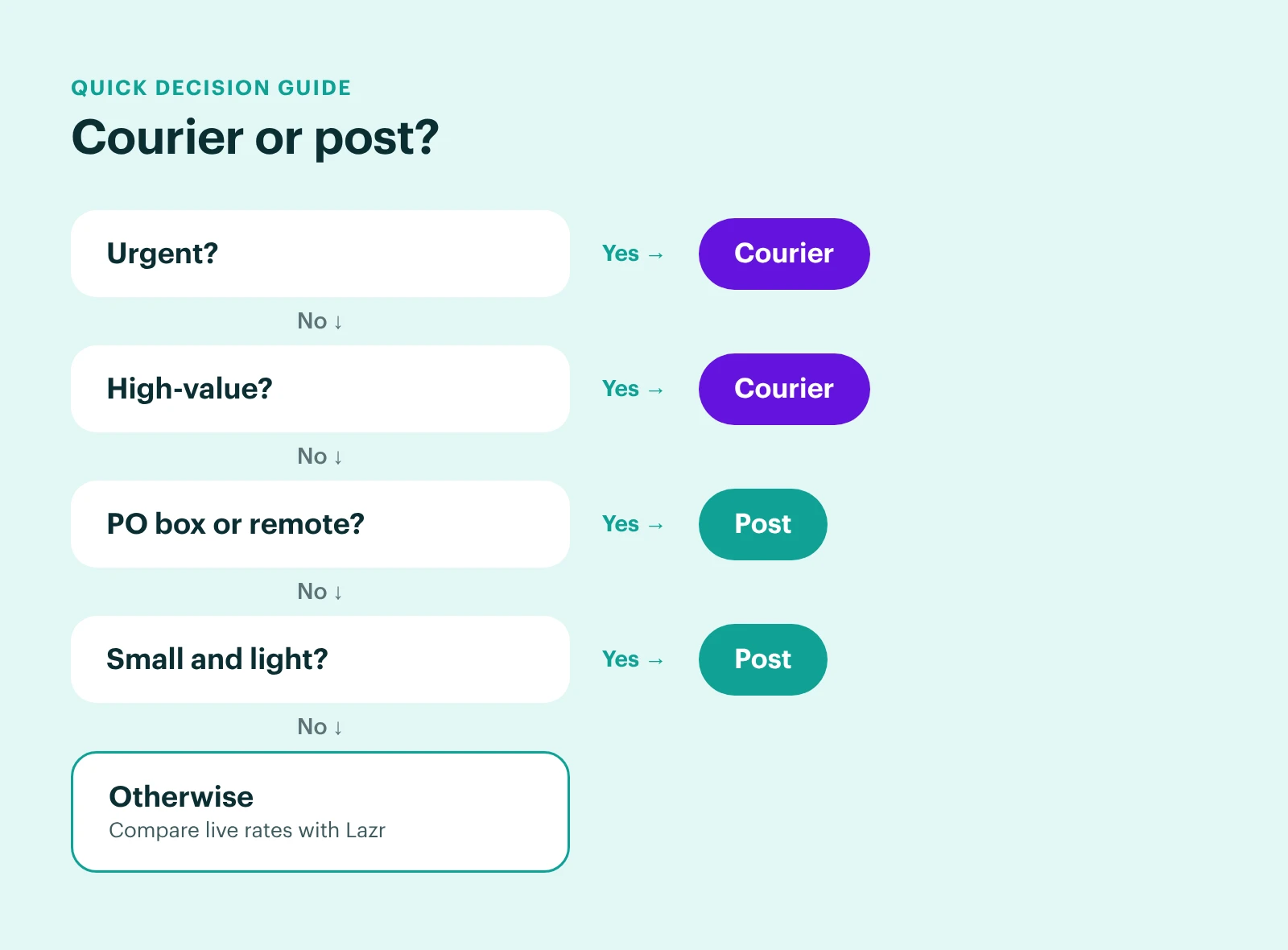
Five factors that should decide courier vs post shipment by shipment
No single factor settles it, but each one tends to push a shipment one way. Use this table as a starting point, then compare the services actually available on the lane before you book.
| Factor | Lean postal when… | Lean courier when… |
|---|---|---|
| Value | The order is low value and the included liability covers what you’d lose | The order is high value and you want declared value, signature and claims support matched to it |
| Urgency | The customer chose economical shipping and a few extra days won’t cost you anything | A late delivery has a direct cost, or the receiver needs a time-definite delivery |
| Weight and dimensions | The parcel is light and compact | The parcel is heavier or bulkier and courier pricing on that lane is competitive (check dimensional weight) |
| Destination | The address is a PO box or a rural or remote residence | The address is commercial, with a dock or business-hours receiving |
| Visibility | Standard tracking and delivery confirmation are enough | The receiver needs proof of delivery or a signature on every shipment, with detailed tracking events |
Three example orders show how this plays out:
- A lightweight ecommerce order to a rural PO box. The destination decides it: couriers generally can’t deliver to PO boxes, so compare Canada Post services and pick the speed that matches your checkout promise.
- An urgent replacement part for a B2B customer. Urgency and visibility dominate. Compare express and time-definite courier services against Priority, and check proof of delivery and what each guarantee covers.
- A heavy order going to the U.S. Weight, dimensions and the border dominate. Compare dimensional-weight pricing and customs handling across postal and courier options, and check when LTL beats parcel if the shipment is outgrowing parcel limits.
1. Urgency and delivery commitment
Ask what a late delivery would cost: a refund, a reship, a lost B2B customer, or nothing at all? If the cost is low, an economical service is usually fine. If it’s high, compare guaranteed and time-definite services, and check what each guarantee actually covers. Canada Post’s domestic On-Time Delivery Guarantee, for instance, doesn’t apply to Regular Parcel, can be modified during peak periods, and doesn’t cover delays caused by events such as weather, labour disruptions or customs (Canada Post Parcel Services Customer Guide, effective October 1, 2026).
2. Shipment value and risk tolerance
The higher the order value, the more a lost or damaged parcel hurts your margin. Match included liability, extra coverage and signature requirements to what you’d actually lose if the parcel went missing.
3. Weight, dimensions, and potential surcharges
Postal and courier services price weight and size differently, and both may bill on dimensional weight. A box that’s cheap with one carrier can trigger an oversize surcharge with another. Measure accurately, run the numbers in a volumetric calculator, and if a shipment is outgrowing parcel limits, check when LTL beats parcel.
4. Destination and last-mile constraints
PO boxes, rural routes, remote communities, residential versus commercial addresses: the destination can rule out services before price even comes into it. Rural or extended-area surcharges can also change which option is cheapest.
5. Tracking, signature, and customer expectations
Think about what your customer expects to see. A B2B receiver may need proof of delivery for accounts payable. An ecommerce shopper may just want accurate updates. Paying for visibility nobody uses is waste, and skipping visibility that’s needed means support tickets.

Courier vs postal service for cross-border shipping
For shipments to the U.S. and beyond, the choice also affects customs clearance, handoffs and tracking. Postal shipments typically move through Canada Post and then the destination postal operator. Couriers often keep the parcel in their own network and offer brokerage options (verify per carrier and service). That can change how fast customs clearance happens, how tracking looks after the border, and who pays duties and brokerage fees. Neither model is better for every cross-border shipment. Accurate documentation matters in both. Our guides to shipping from Canada to the United States and commercial invoices cover the paperwork.
The rules for low-value U.S. shipments have also changed. Since August 29, 2025, the U.S. no longer grants duty-free de minimis treatment (the former US$800 threshold) to shipments from any country, including Canada, and the suspension now applies to mail indefinitely. Canada Post still ships to the U.S., but duties must be assessed and prepaid before it issues a label. Courier shipments go through the commercial entry process instead. These rules keep changing, so check current CBP and carrier guidance before you quote landed costs.
A multi-carrier strategy is usually more useful than choosing one forever
In practice, many Canadian businesses do best with a mix. They might send lightweight residential orders and PO box addresses through Canada Post, time-sensitive B2B orders by courier, and heavier orders to whichever service prices best on that lane. That mix can change with the season, the destination, order value or the delivery promise you make. A multi-carrier shipping approach makes this practical without logging into five carrier portals. Tracking transportation KPIs like on-time performance and cost per shipment tells you when the mix needs adjusting.
A mix also gives you a fallback. Any network can be disrupted by weather, a peak-season surge or a labour dispute; Canada Post’s 2024 strike, for example, stopped parcel service for about a month. Couriers have disruptions too. The point isn’t to pick a side; it’s to have a second network set up and tested before you need it.
Compare courier and postal options in one workflow
One place for every carrier. Lazr is logistics software that centralizes how your team quotes, books, documents and tracks shipments. One search returns live rates from 100+ LTL and parcel carriers, including Canada Post, Purolator, Canpar, UPS, FedEx, DHL and more. You compare service levels and transit times in seconds, then book the service that fits the shipment, not the one you’re used to. Labels, documents and tracking stay centralized, with no separate carrier portals to log into.
Your rates and your store, connected. Already have negotiated carrier rates? Our team imports your rates, keeps them private and factors them into every search, so you always see the best available price. If you sell on Shopify, the Lazr Freight app for Shopify shows live parcel and LTL rates at checkout and is free to install. When orders pile up, you can ship multiple orders in a batch instead of one at a time.
Your whole team, supported. Members can add as many users as they need, so your shipping, customer service and finance teams all work from the same data. When a question comes up, trilingual support (English, French and Spanish) answers within minutes.

Decide before you book. Service availability still depends on the route and shipment. What changes is when you compare: before you book, not after the invoice arrives.
Choose the service that fits the shipment, not the category
There’s no general answer to courier vs post. The answer comes shipment by shipment. Set the criteria that matter for each order (urgency, value, weight, destination and visibility), then compare the services actually available before you book. Some orders will go by Canada Post, others by courier. Across a month of shipping, most businesses end up using both.
Frequently Asked Questions
Is a courier faster than mail?
Not necessarily. Speed depends on the service, not the carrier type. Between most major urban centres, Canada Post lists Priority at next business day, even nationally, and Xpresspost at next day locally and regionally and 2 business days nationally. A courier’s ground service can take several days on a long lane.
Does Canada Post include tracking?
Yes. According to Canada Post, its domestic parcel services (Priority, Xpresspost, Expedited Parcel and Regular Parcel) include tracking and delivery confirmation.
Can couriers deliver to a PO box in Canada?
Generally not. PO boxes are part of Canada Post’s network, and couriers such as Purolator state that they don’t deliver to them. Use a postal service, or ask the recipient for a street address.
Is postal shipping always cheaper than a courier?
Not always. In any Canada Post vs courier comparison, rates depend on weight, dimensions, destination, service level and your contracts. A courier can come in cheaper on some lanes, which is why comparing quotes shipment by shipment matters.
Can I use both Canada Post and couriers in one platform?
Yes. Lazr brings Canada Post, Purolator, UPS, FedEx, DHL and other carriers into one search, so you can compare services and transit times, then book, document and track shipments from one place.
-

Accessorial charges in freight
By Rubi Rodriguez • September 11, 2026Accessorial charges fall into three buckets: predictable service needs, data-driven corrections, and execution-related events. Not all of them can be eliminated, but you can prevent… -

Green shipping
By Rubi Rodriguez • September 4, 2026Green shipping depends on operational choices, not just packaging or marketing claims. Right-sized packaging, appropriate service levels, and shipment consolidation can reduce both costs and… -
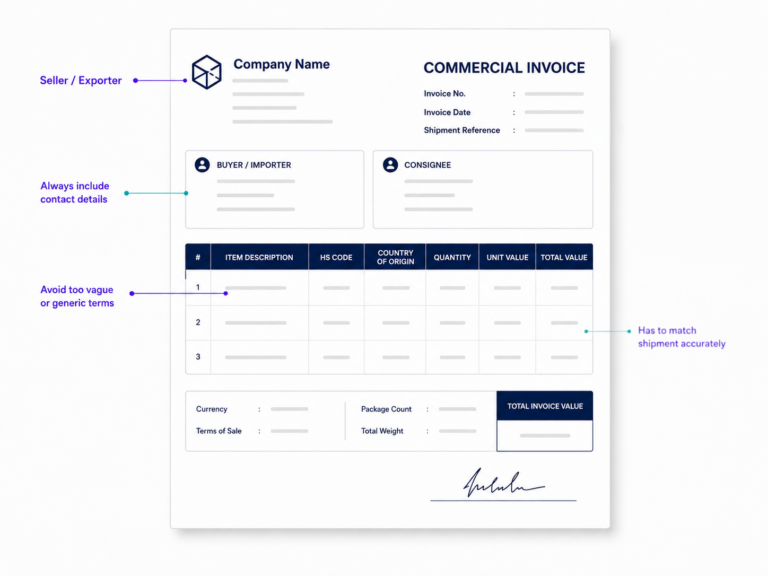
What is a commercial invoice in shipping?
By Rubi Rodriguez • August 28, 2026A commercial invoice must clearly and accurately state the goods, value, parties involved, country of origin, and HS codes to avoid customs delays. Because requirements…