
What is multi-carrier shipping software?
By Rubi Rodriguez
Published on May 8, 2026
In short
Multi-carrier software centralizes operations and reduces fragmentation. Its value lies in operational control, not just pricing. It becomes essential as soon as the complexity exceeds what manual tools can handle.
In short
Multi-carrier software centralizes operations and reduces fragmentation. Its value lies in operational control, not just pricing. It becomes essential as soon as the complexity exceeds what manual tools can handle.
A multi-carrier shipping software is a platform that lets a business manage shipments across several carriers from one place instead of switching between separate carrier portals.
For teams asking what’s the point of a multi-carrier shipping software, the simplest answer is this: it centralizes shipment creation, carrier comparison, labels, tracking, and shipping data in one place, across multiple carriers.
The real value of shipping software with multiple carriers is not just rate shopping. It is building a unified shipping workflow that gives teams better control over carrier selection, execution, exceptions, reporting, and cost visibility. In other words, it becomes a cost-effective shipping control layer between your carriers and your internal systems.
What the right multi-carrier platform actually enables
Better carrier decisions
A strong platform helps teams choose carriers based on more than price. Cost matters, but so do transit time, service level, delivery location, performance history, shipping metrics, claims experience, customs requirements, and customer expectations.
The “cheapest” option is not always the best operational choice. A low rate can become expensive if it creates delays, manual follow-ups, missed delivery windows, or billing corrections.
Cleaner operations
Without software, teams often move between carrier portals, spreadsheets, email threads, and internal systems. That creates friction.
A multi-carrier platform centralizes shipment creation, labels, tracking, documents, and rules as part of broader supply chain automation strategy. Instead of every team member making decisions differently, the business works from one common workflow.
More reliable scaling
Shipping 20 orders a day through separate portals may be manageable. Shipping hundreds, across regions and service levels, is different.
As volume grows, the problem is not only more shipments. It is more exceptions, more service combinations, more customer expectations, and more pressure on internal teams. Multi-carrier software helps standardize the process before complexity becomes unmanageable.
Stronger international shipping control
For importers, exporters, and cross-border shippers, multi-carrier software can also support documentation, visibility, and cost control. In Canada, commercial importers must account for duties and taxes through CBSA processes, and CARM became the official system for assessing and collecting duties and taxes on commercial goods in October 2024.
That makes clean shipment data and connected workflows even more important.

When multi-carrier shipping software becomes more profitable than separate carrier portals
Rate comparison alone is not enough. A platform becomes profitable when it reduces the hidden cost of managing transportation manually.
The tipping point is not just shipment volume
Many teams wait until volume is high before considering shipping software with multiple carriers. Volume matters, but it is not the only trigger.
The tipping point also depends on the number of carriers, markets, service levels, exceptions, users, warehouses, and systems involved. If your team spends too much time choosing services, re-entering shipment data, fixing errors, or chasing tracking updates, the business case is already there.
The hidden cost of managing carriers separately
Separate carrier portals create invisible costs: duplicated data entry, inconsistent service choices, manual label creation, limited reporting, missed rate changes, and no shared logic for carrier allocation.
The biggest issue is that every shipment becomes a small manual decision. Over time, those decisions become hard to govern, hard to measure, and hard to improve.
What to look for if you already have your own carrier accounts
A platform should use your accounts, not replace your strategy
If your business already negotiated carrier accounts, a good platform should help you use them better. It should not force you into a one-size-fits-all carrier setup.
Your negotiated rates, service preferences, and carrier relationships are strategic assets. The platform should centralize and operationalize them.
The real question is control, not just access
Having access to multiple carriers is not the same as controlling your shipping strategy.
The real question is: can you define how carriers are selected? Can you apply rules by destination, weight, service level, customer type, warehouse, delivery promise, or cost threshold? Can your team see why a carrier was chosen?
That is the difference between carrier portal switching and real shipping orchestration.
Which integration criteria matter most for API, ERP and WMS

Delivery platforms often connect with ecommerce, ERP, WMS, and related systems, and its integration ecosystem includes hundreds of integrations. For buyers, the important question is not, “Does it integrate?” It is “What does the integration actually support?”
Data in, decisions out
The platform needs clean data to make good decisions: order details, addresses, dimensions, weights, products, service requirements, customs fields, warehouse location, customer promises, and account rules.
If that data enters the platform incorrectly, automation only makes bad decisions faster.
Exception handling, tracking events and reporting
A useful platform should also send information back to the systems your team already uses. That includes tracking events, label status, shipment cost, selected carrier, delivery exceptions, and reporting data.
This is what turns shipping from a disconnected task into an integrated execution layer.
How to avoid adopting a tool that only does rate shopping
Signs the platform is too shallow
A shallow platform focuses almost entirely on price comparison. It may offer labels and basic tracking, but limited rules, weak reporting, poor exception management, little document control, and minimal international functionality.
That may be fine for simple parcel operations. It is not enough for teams with complex B2B, cross-border, or multi-warehouse needs.
What a real control layer looks like
A real shipping control layer supports carrier allocation, governance, performance tracking, billing reconciliation, exception visibility, documentation, and international shipping requirements.
It helps teams manage the full shipping decision, not just the label.
Questions buyers should ask before selecting a platform
Ask these questions before choosing:
- Can we connect our own carrier accounts?
- Can we automate carrier selection rules?
- Can it integrate with our ERP, WMS, OMS, or ecommerce platform?
- Can we track quote, shipment, delivery, and cost data?
- Can we manage exceptions and reporting from one place?
- Can it support international and cross-border workflows?
A tool for different profiles
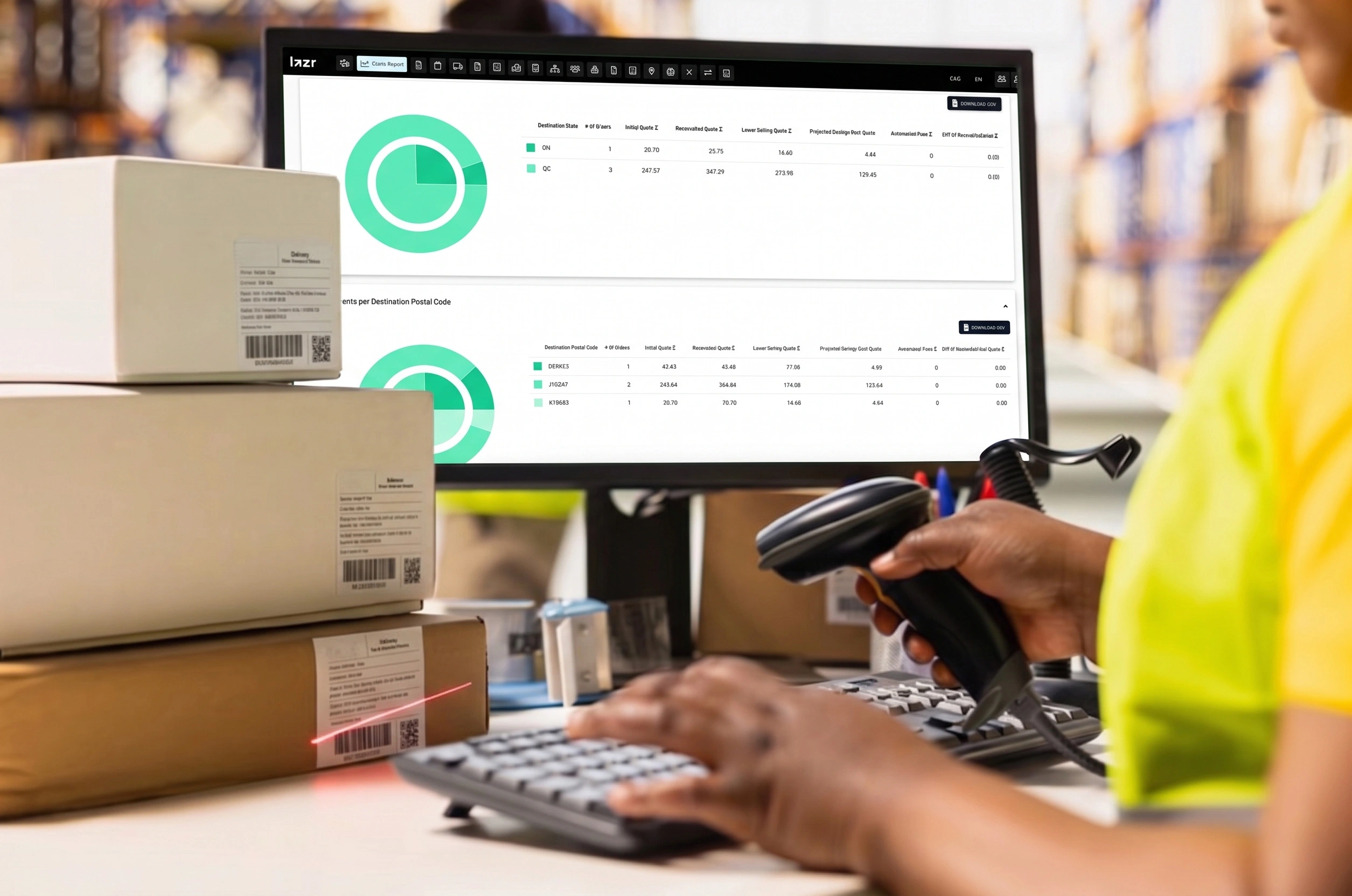
The e-commerce operation managing peak volume spikes
For ecommerce teams, the platform helps handle peak demand without adding unnecessary manual work. Rules can support faster service selection, better tracking, and more consistent delivery execution.
The B2B shipper dealing with complex delivery requirements
B2B shipping often involves appointments, docks, delivery constraints, larger shipments, and customer-specific rules. Multi-carrier software helps standardize those requirements across carriers.
The logistics team inheriting a fragmented carrier setup
Many logistics teams inherit carriers, rates, and processes from different departments or locations. A platform like Lazr helps bring that fragmented setup into one operating model.
The growing brand shipping across multiple markets
For brands expanding across Canada, the U.S., or internationally, multi-carrier software supports better comparisons across lanes, services, carriers, and cost structures.
At Lazr, we see multi-carrier shipping software as more than a way to compare rates. It is a way to bring operational control, visibility, and better decision-making into every shipment.
When teams can connect their carriers, centralize workflows, compare options, and understand performance, they move beyond rate shopping. They start building a shipping operation that can scale with clarity and control.
FAQ
When should a company adopt multi-carrier shipping software?
When shipping complexity increases (multiple carriers, regions, or service levels) software becomes valuable even before volume becomes high.
Does multi-carrier software reduce shipping costs?
Yes, but not only through rate comparison. It reduces operational costs by eliminating manual work, errors, and inefficient carrier choices.
Can I use my own carrier accounts?
Most platforms allow integration of existing carrier accounts, enabling businesses to keep negotiated rates while improving execution.
How does it integrate with ERP or WMS systems?
Through APIs and integrations, allowing shipment data, tracking, and cost information to flow between systems automatically.
-

Accessorial charges in freight
By Rubi Rodriguez • September 11, 2026Accessorial charges fall into three buckets: predictable service needs, data-driven corrections, and execution-related events. Not all of them can be eliminated, but you can prevent… -

Green shipping
By Rubi Rodriguez • September 4, 2026Green shipping depends on operational choices, not just packaging or marketing claims. Right-sized packaging, appropriate service levels, and shipment consolidation can reduce both costs and… -
What is a commercial invoice in shipping?
By Rubi Rodriguez • August 28, 2026A commercial invoice must clearly and accurately state the goods, value, parties involved, country of origin, and HS codes to avoid customs delays. Because requirements…