
What is a packing list and what is it used for?
By Rubi Rodriguez
Published on July 8, 2026
In short
A packing list confirms what was actually shipped, not what was ordered or invoiced, which is why it matters so much at receiving and at customs. It should be treated as a control document with accurate, verifiable fields because even small errors in carton count, quantities, weight, or dimensions can lead to rework, customs delays, and freight invoice disputes.
In short
A packing list confirms what was actually shipped, not what was ordered or invoiced, which is why it matters so much at receiving and at customs. It should be treated as a control document with accurate, verifiable fields because even small errors in carton count, quantities, weight, or dimensions can lead to rework, customs delays, and freight invoice disputes.
What is a packing list and what is it used for?
A packing list is the document that tells everyone downstream what is actually inside a shipment: item counts, weights, dimensions, and carton or pallet breakdown. It travels with the freight, and it gets checked against three things at once: what was ordered, what was received, and what customs expects to see.
That last part is where most teams focus first. But the real value of a packing list shows up after the truck leaves. It is what your warehouse team uses to verify a delivery in minutes instead of hours, what customs uses to clear a shipment without a hold, and what your accounting team uses to catch a billing error before it becomes a dispute.
Key Takeaways
- A packing list confirms what was actually shipped, not what was ordered or invoiced. That distinction matters at receiving and at customs.
- The document needs specific, checkable fields: shipper and consignee, PO reference, SKUs, quantities per carton or pallet, and accurate weights and dimensions.
- Small errors on a packing list, like a wrong carton count or an outdated weight, create rework in receiving, delays at customs, and disputes over freight invoices.
- Treat the packing list as a control document for your operations, not paperwork you fill out after the fact.
How a packing list differs from a commercial invoice
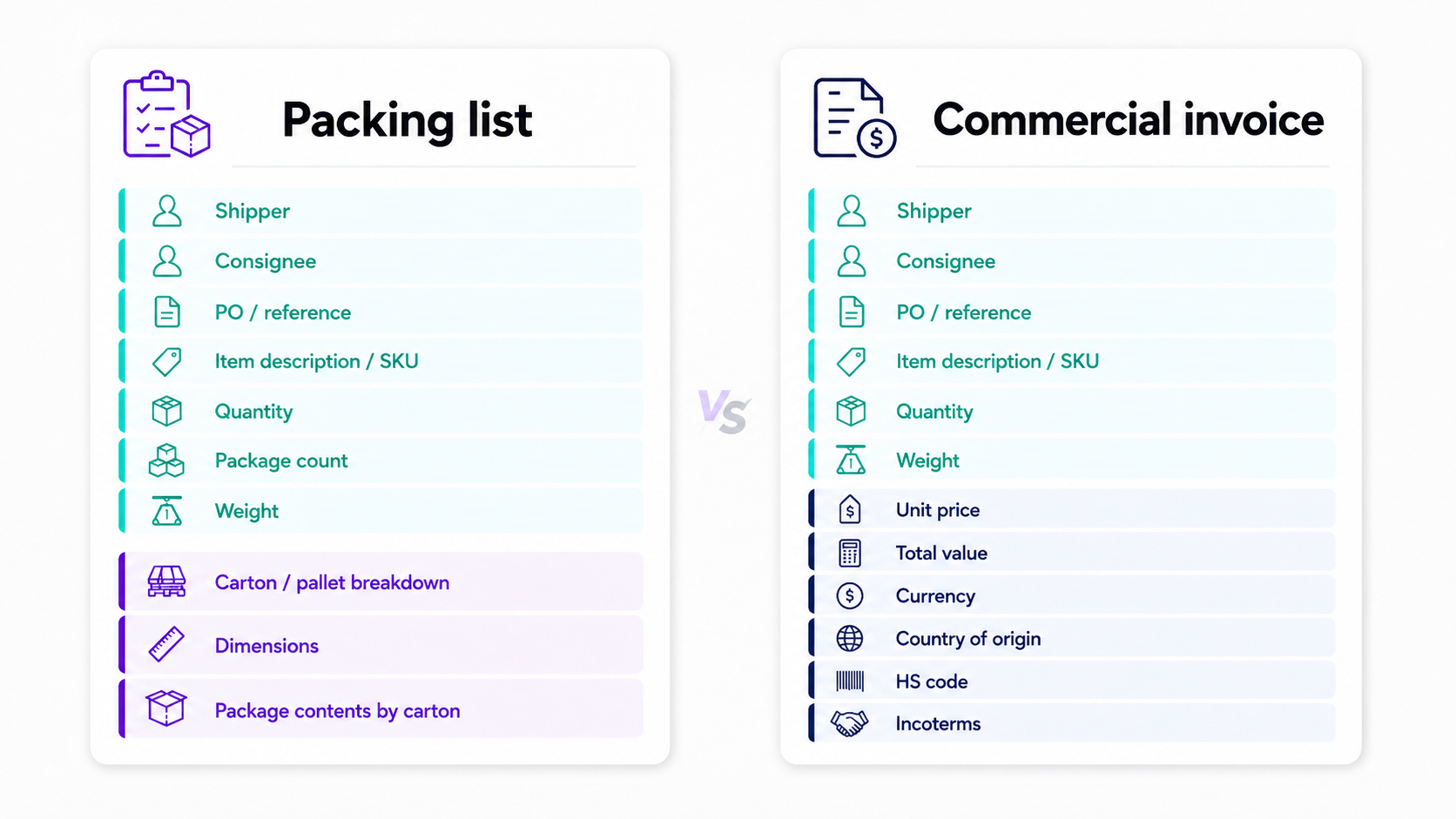
Both documents ride along with a shipment, and both list the goods inside. That is where the overlap ends.
A commercial invoice is a financial document. It states the value of the goods, the terms of sale, and who is responsible for paying duties. Customs and your finance team use it to calculate what is owed.
A packing list is an operational document. It has no pricing on it. It exists to answer one question: what is physically in each carton or pallet, and how much does it weigh? Receiving teams, freight forwarders, and customs brokers all use it to verify the shipment matches what was declared, without needing to know what anything costs.
If your packing list and your commercial invoice show different item counts, that mismatch is exactly the kind of red flag that triggers a customs hold or a receiving dispute.
What should be on a packing list?
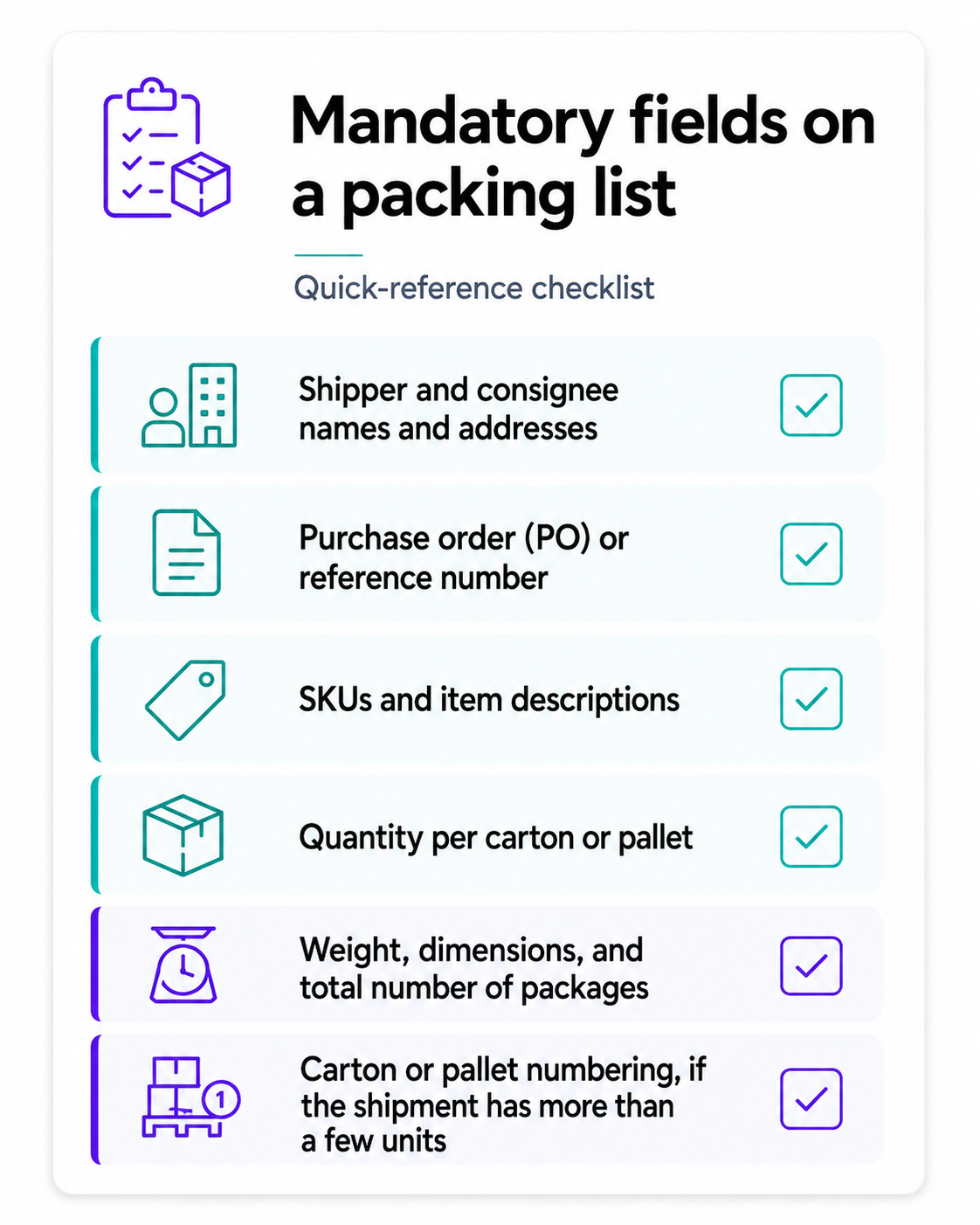
A packing list only works if the fields on it are specific enough to check against a physical shipment. At minimum, it should include:
- shipper and consignee names and addresses
- purchase order (PO) or reference number
- SKUs and item descriptions
- quantity per carton or pallet
- weight, dimensions, and total number of packages
- carton or pallet numbering, if the shipment has more than a few units
Skipping any of these fields does not make the document faster to prepare. It just moves the missing information downstream, where someone at the warehouse or the border has to chase it down manually.
Why packing list accuracy matters operationally
A packing list is only useful if the numbers on it match reality. When they do not, the cost shows up in three specific places.
Better receiving and warehouse checks
Receiving teams use the packing list to confirm a shipment without opening every carton and counting items by hand. When the carton count and weights are accurate, that check takes minutes. When they are wrong, someone has to stop the line, recount, and figure out whether the shipment, the paperwork, or the original order was the problem.
Fewer customs and documentation mismatches
Customs brokers compare the packing list against the commercial invoice and the bill of lading. A mismatch, even a small one like a carton count that is off by two, is enough to trigger a manual review. That review can add days to a clearance that should have taken hours.
Fewer downstream corrections, delays, and claims
If a packing list understates weight or overstates quantity, the error does not stay contained. It shows up again when the carrier invoice does not match the quote, when a claim gets filed for missing items that were never actually shipped, or when a warehouse team has to file an exception report instead of putting the shipment away.

When a bad packing list becomes expensive
The packing list itself is not the expensive part. The expensive part is what a bad one triggers.
According to Customs Support Group and BCG, 20% to 40% of delays are linked to avoidable classification or documentation errors.
Instead of a five-minute receiving check, a warehouse team spends an hour reconciling a shipment where the carton count on the packing list does not match what physically arrived.
Instead of clearing customs same-day, a shipment sits for 48 hours while a broker requests a corrected document.
Instead of a clean invoice reconciliation, accounting flags a freight bill that does not match the declared weight, and someone has to trace the discrepancy back to its source.
None of these are dramatic failures on their own. They are small, repeated frictions that add up across every shipment your business sends.
A clean packing list helps every team after dispatch
A packing list is not a formality you complete because customs requires one. It is the reference document that every team touching a shipment after it leaves your dock relies on: warehouse staff verifying a delivery, a customs broker clearing goods at the border, and an accounting team reconciling a freight invoice.
Getting the fields right the first time, and keeping them consistent with your commercial invoice and your PO, is what keeps that chain from breaking down. A multi-carrier shipping platform that centralizes your shipment data can help generate consistent, accurate documentation across every order, instead of relying on manually rebuilt spreadsheets for each shipment.
FAQ
What is the difference between a packing list and a bill of lading?
A packing list details the contents of each carton or pallet (items, quantities, weights, dimensions). A bill of lading is a legal shipping contract between the shipper and the carrier that also serves as a receipt for the goods and, in some cases, a document of title.
Is a packing list required for every shipment?
Domestic shipments do not always require one, but most freight forwarders, customs brokers, and warehouse receiving teams expect one for any multi-carton or cross-border shipment. Skipping it usually just shifts the verification work onto someone else further down the chain.
Who prepares the packing list?
Typically the shipper or their warehouse team prepares it at the time of packing, based on the confirmed order and the actual cartons or pallets being shipped, not the original PO quantities if those changed.
What happens if the packing list does not match the commercial invoice?
Customs and receiving teams treat that mismatch as a discrepancy that needs resolution before the shipment can be cleared or accepted. This can mean delays, requests for corrected paperwork, or a manual inspection.
-

Accessorial charges in freight
By Rubi Rodriguez • September 11, 2026Accessorial charges fall into three buckets: predictable service needs, data-driven corrections, and execution-related events. Not all of them can be eliminated, but you can prevent… -

Green shipping
By Rubi Rodriguez • September 4, 2026Green shipping depends on operational choices, not just packaging or marketing claims. Right-sized packaging, appropriate service levels, and shipment consolidation can reduce both costs and… -
What is a commercial invoice in shipping?
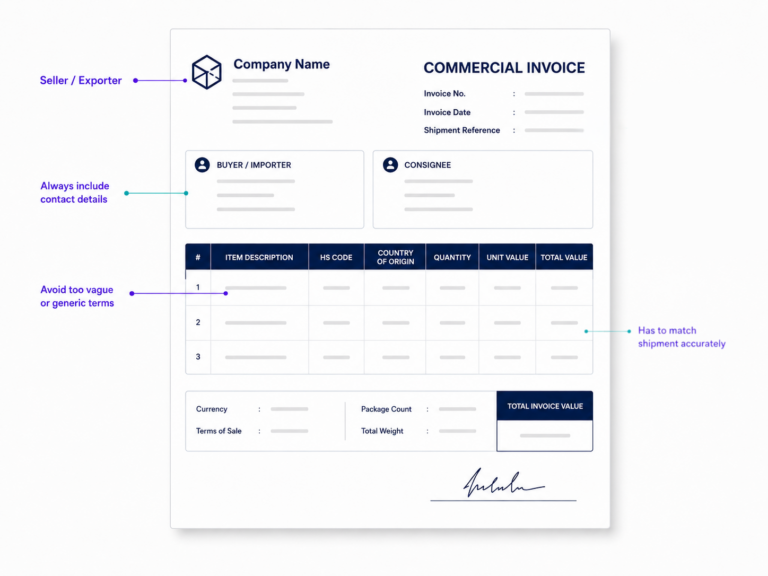
By Rubi Rodriguez • August 28, 2026A commercial invoice must clearly and accurately state the goods, value, parties involved, country of origin, and HS codes to avoid customs delays. Because requirements…