

About this episode
Episode transcript
Introduction
Welcome! This is the first real podcast about transportation. The Lazr podcast. let me introduce myself, my name is Marc-André. I’m CEO at Lazr. Today, I’m here with Mathieu Mathieu has a background pretty advanced in transportation operations. He’s an authority here at our place for all the tricky files. So it’s gonna be fun to talk about it with Matt.
Thanks, Marc. It’s true, when we don’t know what to say, we go see him. Mathieu’s probably got a canned answer ready. Exactly. So when it’s a problem, we call Mathieu.
Meet the Lazr team
Mathieu Gendron, director of operations, part of the team for five years now. I joined the Lazr project with a lot of enthusiasm because it really got to me to see a new product made in Québec in logistics, one that combined technology and transportation. Me, basically, I’ve been in transportation for 20 years.
I started really young, the first step of my journey was as a driver. Then I climbed the ladder up to managing warehouses, managing hundreds of drivers. And then I joined the Lazr project, basically, right at its very beginning. That let me bring a bit of my own touch to developing the operations side of the platform.
We’re really a platform that specializes in shipping LTL freight as well as parcels. We’re talking 20 to 30 thousand transactions a month, hundreds of business partners. And a reach that’s now gone international. Something I wouldn’t even have thought of at the start, because we were really focused on LTL Canada-US. Now, with parcel, we touch a bit of everything, and that brings a reality that’s always dynamic.
And that’s what I love about Lazr. Next, we’ve got Éric Éric, actually, who has a background in business, who worked in business development for a big chunk of his career, we hired him back then to join the team and manage the sales team. And finally, when the previous project wrapped up several years ago, well we found it really interesting that Éric could be part of the project we built, this new startup back then.
And given his more analytical nature, and his skills, it made all the sense in the world for Éric to take over the dev team, which has grown a lot bigger under his leadership.
We’re now up to about ten people on the team, just in development my role is to take care of the product. yeah, a tech side, but I work a lot with Mathieu and with the reps too, figuring out what we need to offer clients. What’s interesting is that Mathieu has a background I’d call technical, not necessarily in your job, but in your everyday life.
So we complement each other really well. And he understands the reality of developers really well. but it’s always a matter of logic, and trying to bring that back to… My role, basically, is to fit a feature inside our architecture and make sure that if we implement that feature, there’s no negative impact on anything else.
Exactly. that balance. It’s really hard to work out. I find it’s about finding something that works between the two. And I think you fill that role exactly, kind of business guy slash technical. At the same time, you know, our goal is to transfer that knowledge to the people who have less of it.
It’s like everything on the business logic side that goes into it. Our dev team is going to be a lot stronger since we started out as an LTL platform. That’s a good differentiator. And it really puts a lot of emphasis on the expertise we have too. Exactly. That’s the side. That’s actually the hard side, when you really think it through.
And the reason I say that is because in LTL there’s less standardization, there are more carriers, more players out there in the market, often with less technology available, especially back in the early years, when there weren’t that many Canadian carriers giving access to their, you know, their web services so we could connect directly.
So we had to fill that automation gap ourselves. It was a lot of work back then, but more and more carriers are modernizing, there’s more bandwidth available. But I’d definitely say LTL is the more technical side, the harder one to build. After that, if you go into parcel, it’s kind of small potatoes compared to LTL in terms of what needs to be done on the automation side, you know,
So if I wanted to build on that, on the technology side, yeah, it does show with carriers, but there are still a lot of small details that don’t necessarily get put in place on the technology side, and that means we, we’ve developed our own recipe for doing these integrations more efficiently, and for building in, I’d say, certain safeguards that let us reduce the operational impact of a new integration.
Yeah, exactly. There still seems, there still seems to be a big fear out there. For example, mostly local carriers, being hesitant to connect via API. They’re afraid of marketplaces. Yeah, the ones who have a love-hate relationship with anything resembling a reseller. Our take has always been that it’s a misplaced fear, because we don’t just show prices,
For my part, I’m a bit like Mathieu, I’ve… I’ve been working in transportation for a really long time, my father was in business in that field, so I started working in transportation. I was probably fourteen or fifteen. I did every job, kind of like Mathieu was saying earlier, sweeping the warehouse floor, driving the forklift.
In the industry, we call it shunting trailers around the yard, going in to do loading in the evenings and on weekends while I was still in school. After that, there was a point where school just wasn’t really for me, so I started working in the office, before going back to school later on, and that’s when I started learning the whole world of truck dispatching.
In reality, we did a lot of LTL Canada-US, so basically it was about building trucking runs mostly originating out of Québec and Ontario, headed everywhere. Back then we worked a lot on a milk-run basis. You’d do local pickups. The warehouse would get reloaded to do the famous little milk run on the US side.
And over the years, well, I thought the reps seemed to have a fun life, you know, you’d see them out in the summer. I was working in the office, and I’d think, “my God, that looks like fun, they’re dressed sharp, and they’re tanned, driving around in their car, going to meet clients…” I felt like there was something jetset about it.
So I told myself, my God, I should be a rep. And my dad wanted nothing to do with it. There was this guy we’d worked with for a really long time, Dan, and he’s the one who convinced my dad. I was 19, and he said, your son, he seems like he wants it, you should give him a chance. And that’s when I started out as a rep on the road.
And I wanted it to work so badly, I wanted it so badly. And it’s like that start, having begun the rep job that young, it’s followed me my whole life. Later, when we started our own transportation businesses, really it was just carrying over the same work ethic, the same logic, the same sales cycle that already existed before, and that’s how we built the businesses.
And I don’t even leave Lazr out of that. Lazr is a bit more, sure, it’s more technical, more of a platform. Sure, there are components that are different in terms of how we do business with clients. But the foundation of it, whether it’s on the customer service side, building relationships with other people, and bringing added value to their own business too, that applies just as much. So that’s how it was done.
And on a personal note, I’d say that, again, the technical side of Lazr interests me a ton. You know, we’re really into everything about good development, coding, and more recently, everything AI. The whole Lazr team is really passionate about that. So I get exactly what I want out of Lazr, with that balance where we bring our experience from the transportation side, the CRM side, the sales team side, but also the coding side, tech projects, and connectivity between businesses. That’s really exciting stuff. which is pretty much where we’re at now.
Why launch a transportation podcast?
And why I thought we could do a podcast that would be interesting and could bring value to the industry. It’s built around the idea of where the company is at right now. like we said a bit earlier, we do tens of thousands a month, whether it’s parcel or LTL, Canada, US, Mexico, international, all kinds.
And that gives us really interesting visibility, you know, we have more than 1000 clients shipping through Lazr every month, that brings together a lot of scenarios, a lot of cases, but it also means we have really good visibility into all the issues people have run into over the past year. A lot has happened, everything around customs, everything around, everything around documentation, you know, I could go on and on. Topics we could name endlessly, but it gives us a perspective and a certain kind of expertise we can share with people to help them whenever a challenge like that comes up.
So over time, I think it’s going to vary from one episode to the next. Maybe sometimes we’ll get into more of a conversation on one specific topic, but other times it might be more about sharing what the best practices are. What are other people doing to improve things, or save money, or optimize their processes?
Whether it’s at the level of shipping itself, in the warehouse, packaging, how orders get sent out, or maybe more at the systems level, what are people doing that works well, that we see elsewhere? What are the best practices in the industry? How do you configure your systems to have good connectivity, so things run smoothly. You know, that’s kind of where I was at, in terms of what this podcast is, and what we want to do with it.
The importance of proper packaging
Definitely. And you know, you were talking about packaging. I think packaging is really the starting point of shipping goods, so choosing the right packaging is essential. People underestimate the surcharges that can come from bad packaging, and we see it all the time. Clients aren’t always that familiar with it, haven’t read the carriers’ terms and conditions. Every carrier has its own packaging guide before you prep your shipment. It’s probably worth referring to it to minimize possible surcharges. So if the cardboard boxes aren’t properly sealed, if it’s not corrugated cardboard, as we say in French. You’re exposing yourself to surcharges, because the package might not be able to go on the conveyor and make its way through the automation at the carrier. Those surcharges are actually pretty significant. We’re talking ten, fifteen, twenty dollars. Sometimes it’s 30, 50, even 75% of the shipping price.
Because the carrier doesn’t want to have to pull a package out of the regular shipping flow. So when a package gets unloaded from the truck and put on the conveyor, no humans touch it, it happens automatically. The risk of error is basically zero. When a human has to carry a box around the warehouse, the risk of error goes up, and that’s why it gets surcharged.
So the type of cardboard box, the space inside the boxes, we’ll always suggest having a box that’s as close as possible to the actual volume of the item inside, to keep it from shifting around and possibly crushing the cardboard or breaking the item inside.
When girth and dimensions become costly
Girth is kind of tied to packaging too. You know, when you have a length limit and your box gets crushed and that changes the measurement, it can become a real problem. I saw a video recently of packaging that looked fine, but all the corners had gotten rounded off in transit, and it was on a conveyor, so it just kept rolling, wouldn’t go up, and suddenly it became non-conveyable. And then you’d get a surcharge.
yeah, girth, basically, is the calculation of the package’s circumference, so, at least in the transportation world, it’s calculated pretty simply, it’s width plus height, times two. And to that, you add the length, length plus two times the width plus two times the height. Yeah, that gives you the girth calculation. But really, for the average person, the point of explaining why it’s a problem is that carriers set really specific rules.
If you go over the girth, that’s about circumference. So let’s be clear, if you exceed their allowed circumference. So, say, I’ll give you a simple example, you couldn’t call a parcel carrier and say come pick up this barrel, let’s say the driver wouldn’t be able to move a barrel with his hands. You get the idea, that’s the general concept, but it applies to much smaller things too, you know, if you have a big roll of something, or a piece with unusual dimensions.
You know, like, dimensions that change depending on which part of the piece, or whatever. So at some point, if you go over the threshold, the fees get really expensive. So on our end, we build in protections to prevent that, to protect people from themselves, basically. Because carriers’ web services won’t necessarily always give you back the final charge you’re going to get billed.
So you get the impression, oh, I’ll ship this through Lazr, I enter my pallet, it costs 22 dollars, and then the invoice comes in at 922 dollars, because you went over the girth calculation, it’s an exception, and it falls outside their normal way of working. But that also applies to lengths, extreme widths, weights, whatever.
On our side, we’re there to protect the client and make sure these things get caught and stop the client from getting blindsided. So, say, I’ll give you an example. We built it so that if the girth, the circumference calculation, is exceeded, the client gets warned, a message pops up, and we guide the client in the right direction, which is to ask for a quote from our team, or simply to make sure the client, the shipper, really knows their dimensions and isn’t just estimating, because every service has a different girth limit.
So the worst-case scenario is if something’s going out by air express and the girth is exceeded, it becomes astronomical, it won’t be a good day when a bill for thousands of dollars shows up. It happens in trucking too, but I don’t have concrete examples, though I’d assume it’s less brutal in trucking.
It’s more of an adjustment of charges based on the dimensions and the space it takes up in the truck, which isn’t necessarily proportional to the weight. In parcel, those charges are really meant as a deterrent. That’s where it gets frustrating, because basically you’re expecting a quote for 125 and you get a bill for 3000.
Well, let’s be honest, there are re-measurements, some every day, on almost every transaction. And with girth it’s really tight. That’s why we built in a buffer, so we’re not sitting right on the carrier’s limit. Because getting rebilled over two-tenths of an inch, that’s a real problem.
We actually lived through that, with a chair that was headed to Europe, the box got crushed, and we ended up going over by an inch and a half, and the charge came in right away. It went over the girth limit because at the time we didn’t have a buffer yet, so the package itself was fine according to the original measurements.
But in transit, the box wasn’t necessarily good quality. It went over once it got scanned, and that triggered the charge, and it triggered frustration for the client afterwards. In LTL, what I’ve seen come up a lot is people saying, okay, I’ve got a 40 by 48 pallet, but what they load onto it overhangs the pallet.
So they’ll enter, I’ve got six 40 by 48 pallets, but say it overhangs by three or four inches on each side, or even two inches a side. So sometimes it won’t fit side by side. In reality, you need to place the two pallets next to each other in the trailer. So you’d planned, say, that it was going to take eight feet of a trailer, or four pallets’ worth, you know, and then it ends up being fourteen feet of a trailer, so it costs several hundred extra dollars, that can happen.
I’ve seen stuff like that happen before. And with common carriers in general, if you look at the automated services that run on cubic measurement, well then, for each pallet, you get rebilled for a bigger cube, so that can make a huge difference. And people are often surprised, we’ve seen invoices come in from big American carriers where the client thought it was going to be 235 dollars and the final bill is 2200 dollars.
That’s another thing you have to watch for. You know, precision, of the data, of what gets entered, you can’t take that lightly. It has a big financial impact for those companies too. You know, your load going from a certain profitability to […]. Oh, absolutely, for sure, if he had said he was committing to pick up four pallets, well, he priced his truck for four pallets’ worth of space. And for sure, it comes back to packaging. You know, sometimes the measurement was actually done correctly with the client. They’ll say, “no, I really measured it, I took photos.” Yeah, but then you look at the photo on the dock, two pallets got banged up, the boxes got crushed.
Actual weight and dimensional weight
We’ve also seen clients talk about the weight of a pallet when they didn’t even have a scale on site. That’s another pattern. “No, no, I know it, it weighs 15 pounds.” “Oh yeah, did you weigh it?” “No, no, but I just know.” But people forget to factor in the weight of the pallet itself.
Also, when something’s lighter, dimensional weight definitely comes into play. Dimensional weight is when you calculate the item’s dimensions and use a math formula to assign it a weight per cubic foot. And it matters a lot to the carrier to know, between the actual weight and the dimensional weight, which one is higher, because that’s wasted space in the truck.
So they’ll always want to bill so they don’t end up with wasted space. Exactly. The classic bricks versus a bag of chips thing. Exactly. The weight is, it’ll be minimal, you’ll feel like you’re shipping nothing, but it’s terrible on space. Exactly.
Those are all things that sometimes get overlooked in order preparation. We do it fast, we want it out the door, but it’s something that needs to be handled upfront. And I think, you know, Lazr reps can help explain what the best practices are there and support you through it.
Claims and high-value goods
There are cases where you’d get problematic claims just because of packaging, right? Well, if the packaging didn’t meet the rules, carriers won’t necessarily move forward with a claim, because, basically, that’s part of the terms and conditions. When you send a package through their network, you’re agreeing to send it the way the carrier expects.
Exactly. But often, with bigger shipments, it’s LTL, or it’s a pallet going out. I’ve heard cases where claims got denied by carriers because the machinery, say, a piece of equipment you’re shipping, wasn’t packaged in an acceptable way. Maybe it was just, say, strapped down loose on a pallet, secured to the pallet itself, but out in the open, let’s say.
And then a forklift blade comes through, a scratch, whatever can happen. None of it would be covered. You know, if it’s not crated properly. We see that regularly. Basically, it’s always important, if you want to ship something high-value, to make sure the way you prep your goods lines up with what’s expected in terms of the claims policy.
Because, like you said, if you’ve just put a machine on a pallet, most carriers will expect it to be crated in a wooden box to protect it, since it’s an extremely fragile, high-value item. We’re obviously not talking about a box of pillows here, in its cardboard box, etc.
And you know, not all carriers have the same tolerance, the same appetite for risk, so there are carriers who’ll take the goods, and others who’ll refuse them when they show up. They’ll say, “I can’t take this, packaged the way it is.” What I like is when they pick up the goods, bring them back to their dock, and then say they can’t take it because it’s not packaged properly.
But you’re never really safe from who the driver is that shows up, how well-trained they are. And from one driver to another, sometimes you’ll get different answers. You know, we’ve often heard clients say, but yesterday it was fine. But the guy yesterday shouldn’t have taken it.
You know, that’s the kind of comment we hear a lot. “I’ve always shipped it this way.” Yeah, but it was never actually fine. “But Gaétan, who comes by on Tuesdays, it never bothered him.” And nobody ever told him otherwise. That’s pretty standard. And, you know, I’ve often heard that with machinery, HVAC units.
You know, stuff that can be worth a lot of money, often. And that can create some pretty serious conflicts. It can get pretty problematic if you ship a machine worth 50,000 dollars on a pallet, and a forklift blade goes right through it, and then you get reimbursed two bucks a pound. If that happens to you, in a case like that, it can get really problematic.
The importance of shipping insurance
The whole declared-value side of things is another thing that not everyone really understands, you know. No, that’s also why it’s important to think about having a declared value, using whatever coverage is available before shipping high-value items. Because otherwise, the carriers’ basic liability will rarely cover the costs tied to a loss.
Carriers, both directly and through platforms, let people opt into that kind of coverage. Exactly. It’s really important. And, you know, it’s not that well known, something that used to happen to me a lot, I’d give clients this example. It’s, imagine you put a machine worth 1 million dollars on a pallet, you don’t tell us, you ship it out to your client, something happens.
Then the claim gets filed. And you say, “it’s going to be 1 million dollars, I want you to reimburse me,” well, of course basic insurance isn’t going to cover something like that. But I think it’s a bit of an education issue for us, getting people to understand what the limits are, how a transportation claim actually works. What you’ll get paid out in the event something’s partially damaged, or a total loss, you know.
There have to be limits, because otherwise transportation couldn’t exist. You know, you couldn’t ship something worth 50 million dollars when we’re making 42 bucks of profit on the transaction. No, nobody would take that risk. You’re absolutely right. Insurance is a whole topic on its own. Shipping a used product and then claiming a certain value on it afterward.
You know, it’s a whole process. Liquid that freezes in winter, the packaging is perfect and fine, but the liquid froze. Is your insurance going to cover that? You know, did you ask for a specific service? It’s funny, but Mathieu and I have tons of stories. You know, some carriers will tell you they offer a “protect from freeze” service, you call them, and then they say, “oh no, we don’t do that here.”
I’ve had someone tell me there’s not even a garage door, that the warehouse is open-air, so there’s no way they can keep the goods protected. These are giants of the industry, not small companies, and even they don’t have control over that. So that’s where, by working with companies like Lazr, where we’ve got expertise behind us, we can say, “no, in that case, you need to ask for a custom quote.”
Why work with a shipping partner?
There’s real protection in having a good partner on your side, that’s for sure and certain. There’s something to that. I’ll give you an example, one of the first big clients who came to us years ago, one of the reasons he was interested in working with our team.
He explained it to me like this: when a problem comes up, a file gets escalated, and it goes up to team leads, supervisors, directors. But often it’s a case where money needs to be spent, or a big decision needs to be made, or an insurance claim, something like that.
So it lands on the director’s desk. The director gets sent one file, then a second, then a third, a fourth, but he’s not necessarily a transportation specialist. He might not even realize, he’s someone with a business background, working at a manufacturer, a very well-trained person. Maybe he’s got a management degree, but no background in transportation. He’s not someone who worked at a transportation desk for years.
You know, so he ends up with one file, two files, three files, and after six months, maybe there are 40 of them, none of them resolved. That creates friction with carriers, blocked accounts, billing problems. He ends up making, in quotes, bad decisions, because really it’s the timing, more than the resolution, that’s driving it, like, “I need to do something with this, it’s been six months.” So, okay, fine, just pay it. Close the file. Let it go. But in reality, when we build the partnership with them, you become our partner, you come into our corner of the ring, so to speak, if you see it that way. On our side, we’ve got trained people, people who know what to do, who know what a claim actually is, who have the right channels to resolve files, get them moving, and to advise on the right call, saying, “no, that one’s a lost cause, you can’t claim that,”
“but this one, yeah, let’s go!” And we’ll handle it, we’ll take care of it for you, and the follow-up will be done properly. The partnership works preventively too, in the sense that it’s important to communicate and ask questions. We have a team of reps, we have people in operations. Before a shipment goes out, you can ask questions, don’t be shy about asking what the right way to do things is, whether you should try to get coverage, whether the way you packaged something will hold up for transport, especially if you have any doubt at all, following past situations, or when you just don’t really know what’s coming. Well, asking questions is important. And we’ll be there to support you with that.
Exactly. And I think a good system will help you catch a lot of those issues before they even happen, you know, but we see it, there are even websites used by thousands of people every month, at big carriers, where part of the responsibility for the quote gets placed on the person sitting behind the screen.
So let me explain. There are sites where you’ll land on a page, and there’s a little note at the bottom saying, “starting at ten linear feet, calculate 1,000 pounds per foot.” But it’s a tiny asterisk, and the person sitting at the screen, who isn’t necessarily used to it, who’s covering for a coworker in shipping, who might not know about that little detail, is going to process the information with what they’ve got, their quote will show a price, and then afterwards you end up with an invoice that doesn’t add up at all.
A system like Lazr fixes that. shipping things out isn’t simple. It can be, but it can also stop being simple pretty quickly too. And how do you handle the knowledge transfer?
But it’s without a system, it’s really tough. If you go on 17 separate carriers’ sites, they’ll each have ten different ways of doing things that seem roughly the same, but it’s not always the same process. And then if someone’s covering for the regular shipper […]. It’s in the details where the bad surprises hide. You know, you end up afterward with invoices that are hard to justify, but they end up as a loss.
I know it’s like a lot of subjects, at the start you show up and go, “okay, I need to learn this, it’s pretty complicated.” Then, after a while, most team members go through the same thing, you kind of settle into a comfort zone and say, “okay, it’s not so bad, it’s going fine, I know quite a bit now, I’ve become an expert.”
And then after three months, six months, you realize you actually didn’t know much at all. And then you realize just how complicated it is, you know, whether it’s claims, like you said, cubic weight rules, customs paperwork, exceptions, there are tons of them. Every single day, we get calls or requests from clients who need help from our in-house experts, whether it’s about customs or about packaging. On the warehouse side, it goes deep, you know, you can get really refined in that area. You can even become an expert in just one of those subjects, on its own.
Rate increases and new pickup fees
Okay, after that, I thought we could talk about, there was that whole carrier rate increase side of things, price hikes, you know, FedEx, UPS, Purolator, DHL, they’ve all announced increases of 5 to 6% this year. You know, all the clients kind of get caught up in that. And I think the idea of price comparison, and being able to open things up to the market, isn’t always easy, it’s not always something simple. So, you know, we come in with an interesting solution for that.
But you know, pricing is always an issue every year, the rate increases, and making sure the negotiations go well. But what really caught my attention at the start of the year was the pickup fees. I thought that was the biggest change. It really changed the way things worked. You know, someone shipping a single package, the pickup fee can end up being just as high, with certain carriers, as the shipment itself.
In the US, we were already familiar with pickup fees. You know, there was a whole naming system, actually pretty long, you had, like, 3 to 5 different kinds, future pickup, same-day pickup, web-request pickup. Those were fees we were used to, most of the time they’re negotiable. And then, in Canada, carriers started following suit.
Some carriers took the leap and started adding pickup transportation fees. I’d be curious to know if they think it’s a good move, whether they haven’t lost volume because of it, because it can add up to a pretty significant charge. In the US, it could reach 20 dollars per shipment, if I’m not mistaken. And an example we could give is if you’re ever a shipper based in Québec and you need to send goods by parcel, whether to Canada or the US, and let’s take the scenario where you’ve got five packages to send out this week.
If you ship one package every day, you’re going to get charged the fee five times. Say it costs 2 dollars on top of 11 dollars, if they’re shipped on different days. Exactly. Versus if you wait the whole week, you change your promised transit time to your clients. Not every company can do that, but when you can, and you’d ship once a week with a weekly pickup, say on Friday, those same five all at once, the same five we talked about, you’ll maybe pay the 2 dollar pickup fee just once, instead of paying it five times over the week. Right, so on the scenario I just laid out, say it’s five times, at, let’s say, 55 dollars, and you save ten, that’s a 20% difference.
That can add up, it can be pretty significant. Of course, when transit time is the issue, say, I’m talking about maybe a Shopify store that can’t really afford to wait three days every time. That’s where a marketplace becomes interesting too, because not every carrier has added those charges.
Exactly. So that’s where it can start to shift the picture a bit, in terms of which carriers you use. But in reality, in the real day-to-day of the shippers we know, generally it’s a lot more complex than that. You’ve got a large volume of shipments, and optimizing that, within your day, maybe within a two-day window, and figuring out when orders are actually going to go out, there’s kind of a pattern that’s a bit more complicated than the very simplistic scenario I was laying out.
Yeah, exactly. And especially maybe for companies that are less experienced with this, that don’t have as steady a volume, they can see fluctuations pretty fast. Do they even have the ability to wait and store that stock before it ships out too? You know, we see that a lot.
Conclusion
Today we covered a bunch of topics. This was super interesting, thanks guys. Topics around packaging, around the cubic measurement of goods, a couple of client stories. Next time we could do, like Éric was saying earlier, we could share real-life experiences from other clients.
You know, that we’ve actually lived through. I think that could be interesting for people. So next week, we’ll talk about some other news. We’ll keep everyone posted on tariffs. What’s going on. There’s news coming up on that front. We’re going to pick a few topics, jot down a couple of events that happen to real companies here so we can give examples, build on that a bit, and guide people on what the best practices are for them.
Thank you so much. Thanks.
-

Accessorial charges in freight: what they are and how to prevent unexpected fees
By Rubi Rodriguez • September 11, 2026Accessorial charges fall into three buckets: predictable service needs, data-driven corrections, and execution-related events. Not all of them can be eliminated, but you can prevent… -
Green shipping: reduce shipping waste and costs without slowing fulfillment
By Rubi Rodriguez • September 4, 2026Green shipping depends on operational choices, not just packaging or marketing claims. Right-sized packaging, appropriate service levels, and shipment consolidation can reduce both costs and… -
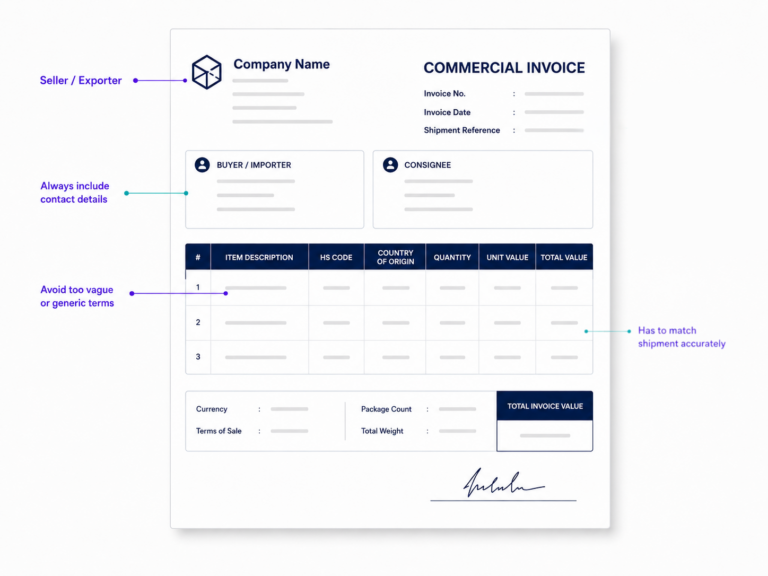
What is a commercial invoice in shipping?
By Rubi Rodriguez • August 28, 2026A commercial invoice must clearly and accurately state the goods, value, parties involved, country of origin, and HS codes to avoid customs delays. Because requirements…