
Green shipping
By Rubi Rodriguez
Published on September 4, 2026
In short
Green shipping depends on operational choices, not just packaging or marketing claims. Right-sized packaging, appropriate service levels, and shipment consolidation can reduce both costs and environmental impact. Tracking packaging use, split shipments, and failed deliveries helps identify where waste occurs and where improvements will have the greatest impact.
In short
Green shipping depends on operational choices, not just packaging or marketing claims. Right-sized packaging, appropriate service levels, and shipment consolidation can reduce both costs and environmental impact. Tracking packaging use, split shipments, and failed deliveries helps identify where waste occurs and where improvements will have the greatest impact.
Reduce shipping waste and costs without slowing fulfillment
Green shipping gets treated as a marketing checkbox more often than an operational one, but the most credible actions here are also good cost and efficiency decisions. Right-sized packaging, better mode selection, and fewer wasted movements reduce both your environmental footprint and your shipping bill, while broader initiatives such as Canada’s Green Shipping Corridors are working to reduce emissions within the transportation infrastructure itself. This guide focuses on the measurable, controllable changes a shipping team can actually make.
Key Takeaways
- Green shipping is a set of operational decisions, not a packaging purchase or a marketing claim.
- Right-sized packaging, matched service levels, and shipment consolidation reduce cost and waste at the same time.
- Defaulting every order to the fastest service level adds cost and impact without adding value for most customers.
- Measuring packaging usage, split shipments, and failed deliveries shows you where waste is actually happening before you set a target.
What green shipping means at the operational level
Green shipping means reducing unnecessary resources, movements, and inefficiencies across the entire shipping workflow, not just buying packaging labeled as eco-friendly. Every avoidable box, wasted trip, or failed delivery has both a cost and an environmental impact, which is why the most effective actions here tend to show up on the P&L as well as in a sustainability report.
Start by removing unnecessary packaging
Right-size boxes and mailers to the product
Oversized packaging adds material cost and often increases the billable dimensional weight of a shipment, so shrinking the box to match the product usually pays for itself directly.
Reduce void fill without increasing damage risk
Cutting void fill volume works only if the product still arrives intact. The goal is less material, not more damage claims, so test any reduction against actual transit conditions first.

Standardize a smaller set of efficient packaging formats
Fewer, well-chosen box sizes simplify picking and packing while reducing the amount of oversized or mismatched packaging used by default.
Less material used means less volume being billed, better use of truck and container space, and a simpler packing process for warehouse staff.
Choose the service that matches the real delivery need
Avoid defaulting every shipment to the fastest service
Expedited service adds cost and typically increases emissions per shipment, and most orders do not actually need next-day delivery to satisfy the customer.
Compare service levels, not just carrier names
Two carriers offering similar-sounding standard service can have meaningfully different transit times and reliability, so the comparison needs to happen at the service level, not just the carrier brand.
Use delivery promises that reflect customer expectations
Setting a delivery promise based on what the customer actually expects, rather than the fastest available option, avoids paying for speed that does not change the buying decision.
An oversized service level increases cost and impact without creating value for the customer receiving the package.
Consolidate shipments when it reduces total movement
Combine orders or replenishment intelligently
Batching orders headed to the same region, or timing replenishment shipments together, reduces the total number of movements needed to deliver the same volume. Freight consolidation works well when the timing lines up with actual demand, not just a fixed schedule.
Balance consolidation against fulfillment delays
Waiting too long to batch a shipment can push it past the point where consolidation savings are worth the delay to the customer, so any consolidation rule needs a clear cutoff.
Reduce split shipments caused by poor inventory visibility
A split shipment usually means two or more separate movements instead of one, often triggered by inventory that was not visible or accurate at the time of order.
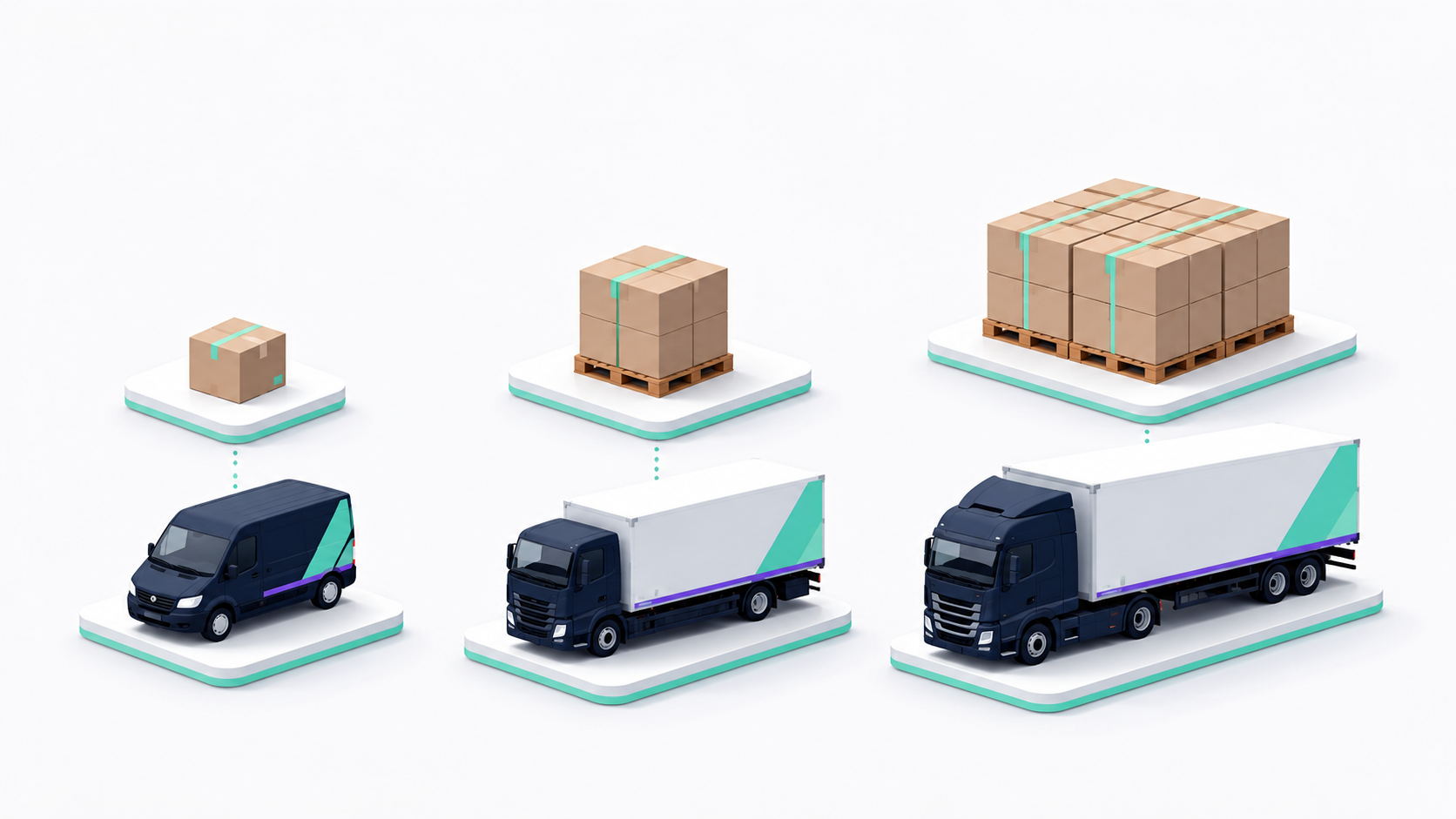
Use the right mode for parcel, pallet, and LTL freight
Avoid parcelizing freight that should move on a pallet
Splitting a large or heavy order into multiple parcel boxes to avoid palletizing it usually costs more and moves less efficiently than shipping it correctly the first time, and it is worth choosing between FTL, LTL and PTL based on the actual volume rather than habit.
Avoid underfilled or poorly planned pallet and LTL moves
An underfilled pallet or LTL shipment still takes up space and creates a movement, without carrying a full, efficient load.
Compare modes based on volume, urgency, and destination
Matching parcel, pallet, LTL and, where relevant, even marine freight to the actual volume, urgency, and destination of each shipment removes both cost and unnecessary movement from the network. For international and coastal supply chains, the environmental performance of the underlying route may increasingly matter as well, particularly as initiatives such as Canada’s Green Shipping Corridors expand cleaner port infrastructure and vessel technologies.
Green shipping corridors are changing the infrastructure behind freight
Green shipping is not limited to decisions made inside the warehouse. In Canada, the federal government is supporting the development of green shipping corridors, defined as zero-emission maritime routes between two or more ports. The goal is to accelerate the adoption of cleaner vessels, fuels, technologies and port infrastructure across major Canadian trade routes.
Through the Green Shipping Corridor Program, Transport Canada is funding projects along the Great Lakes, St. Lawrence Seaway and Canada’s East and West Coasts. Investments include shore power, electrified port equipment, vessel charging, clean-fuel infrastructure and demonstrations of low- and zero-emission vessel technologies.
For shippers, this reinforces a broader principle: greener freight increasingly depends on both how shipments are planned and which transportation networks, modes and services they move through.
Canada’s Green Shipping Corridor Program in numbers
$127.2M
Allocated to clean port infrastructure
$22.5M
Allocated to clean-vessel demonstration projects
Through 2027–28 · Source: Transport Canada
Reduce failed deliveries, returns, and repeat transportation
Improve address and shipment-data accuracy
A failed delivery caused by an incorrect address or missing unit number triggers an entirely repeated shipment, doubling the cost and the impact of that one order.
Match packaging protection to actual product risk
Underprotecting a fragile item leads to damage and a return shipment, while overprotecting a durable item wastes material. Matching protection to actual product risk avoids both.
Make tracking and delivery communication easier to use
Clear, accessible tracking and delivery updates reduce missed deliveries caused by a customer who was not available or not informed of the delivery window.
Measure operational waste before making green claims
Before setting a sustainability target, track a few core metrics so the claim behind it is defensible:
- Packaging usage and dimensional weight
- Split-shipment rate
- Expedited-service usage
- Failed deliveries and returns
- Cost per shipment and cost per order
- Carrier, mode, lane, and service-level patterns
How shipping orchestration supports greener decisions
A platform that compares services across carriers, centralizes parcel, pallet, and LTL booking under consistent rules, and gives visibility into shipment-level data makes it possible to spot the costly or unnecessary behaviors described above. Comparing transportation KPIs across carriers and lanes, rather than reviewing invoices individually, is what actually surfaces these patterns at scale.
Lazr does not position itself as a certified emissions calculator, and this article does not treat it as one. What it offers is the comparison and visibility layer that lets a shipping team act on the decisions above.
Practical green shipping is usually better shipping
The most credible actions reduce waste, handling, cost, and errors at the same time, without sacrificing the service customers actually need. Treat green shipping as an operational discipline built on measurable decisions, not a claim, and the cost savings tend to follow the same path as the emissions reduction.
Frequently Asked Questions
What is green shipping in practical terms?
It means reducing unnecessary packaging, movements, and service-level mismatches across the shipping workflow, rather than relying on eco-labeled materials alone.
Does consolidating shipments always reduce shipping costs?
Usually, but not always. Consolidation reduces cost and movement when timing aligns with actual demand, but waiting too long to batch a shipment can create delivery delays that outweigh the savings.
How does right-sized packaging lower shipping costs?
Smaller, better-matched packaging reduces material cost and often reduces the billable dimensional weight used to calculate the freight charge, which lowers cost independently of any sustainability goal.
What metrics should I track before setting a green shipping target?
Useful starting metrics include packaging usage and dimensional weight, split-shipment rate, expedited-service usage, failed deliveries and returns, and cost per shipment across carriers and lanes.
Is Lazr a carbon emissions calculator?
No. Lazr provides comparison, consolidation, and visibility tools across carriers and shipping modes. It does not currently function as a certified emissions calculator.
-
 Rubi Rodriguez · October 19, 2026
Courier vs post: which is right for you?
Courier vs post (or courier vs mail, as many people search it) isn’t a contest with one permanent winner. Canada Post offers tracked and expedited… -
 Rubi Rodriguez · September 11, 2026
Accessorial charges in freight
Accessorial charges fall into three buckets: predictable service needs, data-driven corrections, and execution-related events. Not all of them can be eliminated, but you can prevent… -
 Rubi Rodriguez · August 28, 2026
What is a commercial invoice in shipping?
A commercial invoice must clearly and accurately state the goods, value, parties involved, country of origin, and HS codes to avoid customs delays. Because requirements…