
What Is a Purchase Order & How Do They Work?
By Rubi Rodriguez
Published on July 17, 2026
In short
A purchase order, or PO, is the document a buyer sends a supplier to formally request goods or services at an agreed price and quantity. Once the supplier accepts it, the PO becomes a binding commitment on both sides. That is the textbook definition. The more useful way to think about a purchase order is…
In short
A purchase order, or PO, is the document a buyer sends a supplier to formally request goods or services at an agreed price and quantity. Once the supplier accepts it, the PO becomes a binding commitment on both sides. That is the textbook definition. The more useful way to think about a purchase order is…
A purchase order, or PO, is the document a buyer sends a supplier to formally request goods or services at an agreed price and quantity. Once the supplier accepts it, the PO becomes a binding commitment on both sides.
That is the textbook definition. The more useful way to think about a purchase order is as the starting point of everything that happens next: what gets received, what gets checked against the invoice, and what gets paid. A clean PO makes every one of those steps faster. A vague or inconsistent one creates work for procurement, receiving, and finance alike.
Key Takeaways
- A purchase order formalizes what will be received, in what quantity, at what price, and under what terms, before the goods ever ship.
- The main PO types (standard, planned, blanket, and recurring) exist to match different buying patterns, not just paperwork preference.
- The purchase order comes first, and the invoice comes after; that sequence is what makes a three-way match possible.
- PO quality directly affects receiving accuracy and invoice reconciliation. A vague PO creates disputes later, even if it saved time upfront.
What is a purchase order and what is its purpose?
A purchase order exists to remove ambiguity from a transaction before it happens. Instead of a verbal agreement or an informal email, the PO states exactly what is being bought, from whom, at what price, and on what terms.
That formalization matters downstream. When goods arrive, the receiving team checks them against the PO, not against memory or a phone call. When the invoice arrives, accounts payable checks it against the PO and the receiving record. A purchase order is what makes that verification possible in the first place.
The PO lifecycle
A purchase order goes through many team’s hands through its usage.
- creation
- approval
- issuance to supplier
- receiving
- invoice matching
- payment

What information should be on a purchase order?
At minimum, a purchase order should include:
- PO number
- supplier name and contact information
- itemized list of goods or services
- quantities and unit prices
- delivery date and shipping terms
- payment terms
Leaving out any of these fields shifts the ambiguity onto whoever handles the shipment or the invoice later, exactly the problem the PO was meant to prevent.
What are the different types of purchase orders?
Not every purchase fits the same pattern, so PO types exist to match different buying needs:
| PO type | Best fit for |
|---|---|
| Standard | One-time purchases with a fixed quantity, price, and delivery date |
| Planned | Purchases where the general terms are set but delivery dates are still tentative |
| Blanket | Repeat purchases from the same supplier over a period, without committing to exact quantities upfront |
| Recurring | Scheduled purchases at set intervals, useful for predictable, ongoing needs |
Using the wrong type does not break the process, but it does create more manual follow-up than necessary. A blanket PO used for a genuinely one-time purchase, for example, adds tracking overhead with no real benefit.
How do purchase orders work in practice?
Where the purchase order sits in the process
The PO sits between the buying decision and the physical transaction. It is created after a business decides what it needs, sent to the supplier for acceptance, and then referenced by every team that touches the transaction afterward: receiving, warehouse, and finance.
What comes first: purchase order or invoice?
The purchase order comes first. The invoice comes after the goods or services are delivered. This order matters because it is what enables a three-way match: the PO states what was agreed, the receiving record confirms what arrived, and the invoice states what is being billed. Without a PO to anchor that comparison, accounts payable has no independent reference to check the invoice against.
What is purchase order management?
Purchase order management covers the full lifecycle of a PO: creation, internal approval, issuance to the supplier, tracking through fulfillment, receiving confirmation, and reconciliation against the final invoice.
Done manually, this usually means tracking PO status across email threads and spreadsheets, which works for low volume and breaks down as the number of active POs grows.
How does your PO affect efficient shipping?
A purchase order might look like a procurement document, but it sets the terms for the shipment before it even happens. Quantities, delivery dates, and supplier details on the PO directly shape how transport gets booked and scheduled.
When a PO is accurate and issued early, your team can plan the right mode, carrier, and service level in advance, instead of scrambling to book transport once goods are already ready to move. When a PO changes late, or was vague to begin with, that uncertainty gets passed straight to whoever is arranging the shipment, often meaning a more expensive, less efficient option booked at the last minute.
In practice, this means a clean PO doesn’t just protect receiving and invoicing. It gives your transport team the lead time and accurate details needed to book efficiently instead of reactively.
Why does PO quality affects receiving, invoicing, and reconciliation ?
Better purchase orders lead to cleaner receiving
When a PO clearly states quantities, SKUs, and delivery terms, receiving teams can verify a shipment quickly against a specific reference. When it is vague, receiving has to guess, call procurement, or accept the shipment on faith and sort out discrepancies later.
Invoice vs PO reconciliation starts with accurate upstream data
A three-way match (PO, receiving record, and invoice) only works if the PO itself was accurate to begin with. If the original PO had the wrong quantity or price, every downstream check inherits that error, and someone in accounts payable ends up manually resolving a discrepancy that started weeks earlier at the ordering stage.
That same upstream error also distorts your total landed cost, since a wrong quantity or price on the PO throws off every cost calculation built on top of it, from freight allocation to duties to final unit cost.
Why purchase orders matter operationally, not just financially
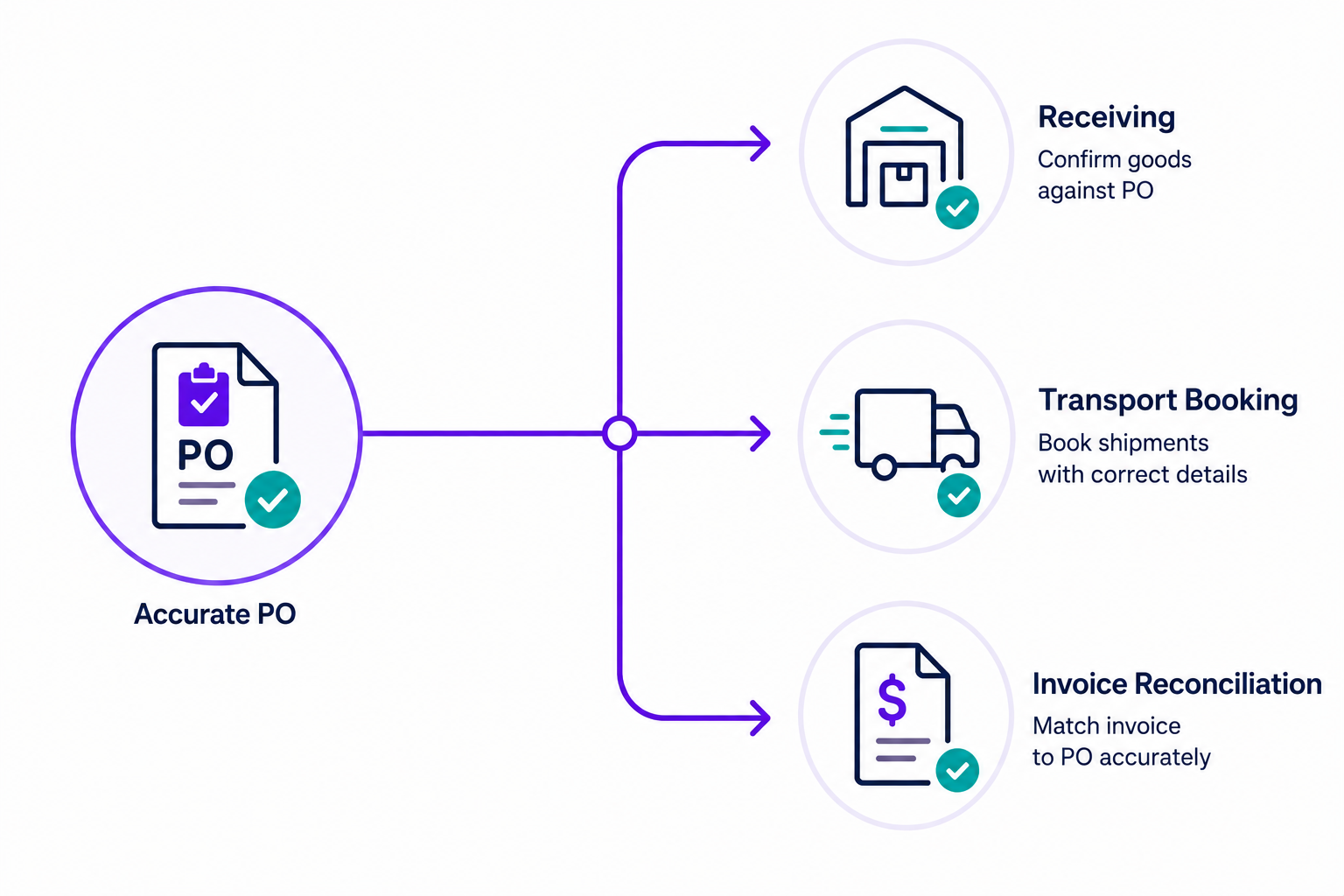
It is easy to treat the purchase order as an accounting formality, something finance needs for the books. In practice, it is closer to the starting instruction set for a chain of operational decisions: what receiving expects, what warehouse teams prepare space for, and what transport needs to be arranged.
This is where digital freight solutions earn their place. A platform that connects PO data to receiving, transport booking, and invoice reconciliation gives operations teams one consistent reference point, instead of re-entering the same information into separate systems at each stage.
Getting purchase orders right at the source is what keeps procurement, receiving, and transport working from the same information instead of reconciling separate versions of it after the fact.
FAQ
What is the purpose of a purchase order?
A purchase order formalizes a purchase agreement before goods or services are delivered, stating exactly what is being bought, at what price, and under what terms. It becomes the reference point for receiving and invoicing later.
What is purchase order management?
Purchase order management is the process of creating, approving, issuing, tracking, and reconciling POs across their full lifecycle, from initial request through to invoice matching and payment.
What are the different types of purchase orders?
The main types are standard (one-time, fixed terms), planned (terms set, delivery date tentative), blanket (repeat purchases without fixed quantities), and recurring (scheduled purchases at set intervals).
What comes first, the invoice or the purchase order?
The purchase order comes first. It is issued and accepted before delivery. The invoice is sent afterward, once goods or services have been delivered, and it is checked against the original PO and the receiving record.
-
Green shipping: reduce shipping waste and costs without slowing fulfillment
By Rubi Rodriguez • September 4, 2026Green shipping depends on operational choices, not just packaging or marketing claims. Right-sized packaging, appropriate service levels, and shipment consolidation can reduce both costs and… -
What is a commercial invoice in shipping?
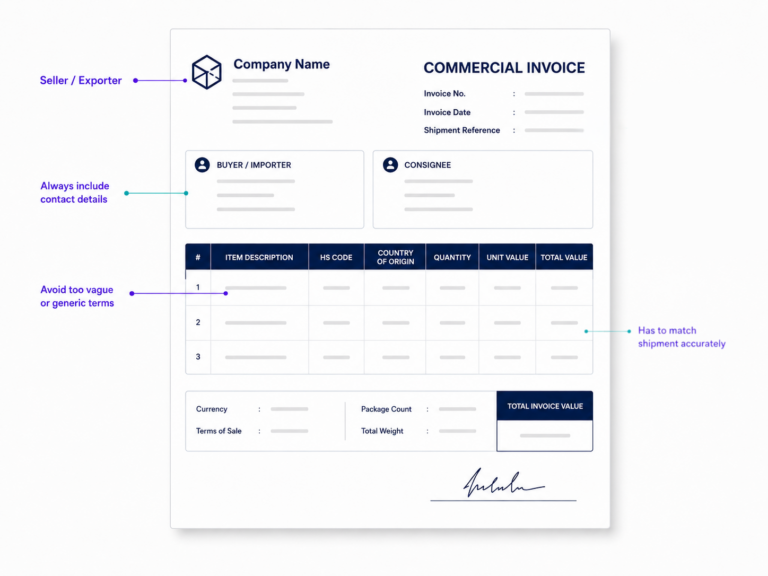
By Rubi Rodriguez • August 28, 2026A commercial invoice must clearly and accurately state the goods, value, parties involved, country of origin, and HS codes to avoid customs delays. Because requirements… -

Pallet shipping: prepare, quote, and move palletized freight without costly mistakes
By Rubi Rodriguez • August 21, 2026Most pallet shipping cost overruns come from inaccurate shipment data rather than the carrier rate itself. The best quote is the one that reflects complete…