
Shipping from Canada to the United States: the most costly mistakes (and how to avoid them)
By Rubi Rodriguez
Published on April 17, 2026
In short
Data errors are the primary source of hidden costs in cross-border trade. Elements such as HS codes, declared value, and documentation directly impact both costs and lead times, while misunderstood Incoterms introduce liability risks and shipment delays. In this context, data standardization and quality remain the most effective levers to reduce errors.
In short
Data errors are the primary source of hidden costs in cross-border trade. Elements such as HS codes, declared value, and documentation directly impact both costs and lead times, while misunderstood Incoterms introduce liability risks and shipment delays. In this context, data standardization and quality remain the most effective levers to reduce errors.
Shipping from Canada to the U.S. looks simple, until it is not. The border adds classification rules, customs documentation, product-specific requirements, and shared responsibilities between exporter and importer.
That is why small data gaps can quickly turn into delays, rework, chargebacks, or avoidable duty issues.
At Lazr, we see the same pattern again and again: cross-border freight gets expensive when the process is fragmented.
Learn how using a cross-border shipping compliance checklist helps reduce that risk.
The complexity of cross-border shipping between Canada and the U.S.
Canada–U.S. shipping is operationally demanding because two compliance environments meet in one shipment. Exporters need to understand what Canada requires on the way out, what U.S. Customs and Border Protection expects on the way in, and whether the product also falls under additional agency rules or permit requirements.
The work is not just transportation. It is trade compliance, documentation quality, and timing.
Most cross-border problems do not start at the dock. They start in the data. When classification, value, origin, or responsibility fields are incomplete, the shipment may still move, but complications show up later in clearance, billing, or delivery.

The most costly cross-border shipping mistakes
The most common mistakes are usually the most expensive:
- Incorrect HS classification
- Missing or incomplete documentation
- Misunderstanding Incoterms and responsibilities
- Incorrect declared value
None of these are minor admin issues. They affect duties, carrier handling, who is responsible when something goes wrong, and whether adequate shipping insurance coverage is in place.
What HS codes are and why they matter in cross-border shipping
HS codes are the global product-classification language used in international trade. They are harmonized internationally to the 6-digit level and are used to determine how goods are described, assessed, and treated at the border. In practice, the code influences duty treatment, documentation, and customs review. They can be found by using online tools provided by customs authorities like Canada Tariff Finder.
Understanding duties, tariffs, and import fees
How duties are calculated
Duties are fees charged by the importing country’s customs authority on goods crossing the border. They are calculated as a percentage of the shipment’s declared customs value and exist to regulate trade and protect domestic industries.
Every duty calculation comes down to three inputs: the HS code (Harmonized System classification), the customs value of the shipment, and the country of origin.
The role of tariffs and trade agreements
Tariffs are the government-set rate schedules that determine what duty percentage applies to a given product. Think of tariffs as the rulebook, and duties as the resulting charge. Trade agreements, like the USMCA (the Canada-US-Mexico Agreement) can lower duty costs, but only when the shipment qualifies. That depends on the product’s origin, the applicable rules, and the supporting documents.
A trade agreement claim that cannot be supported can result in back-duties, interest, and penalties on the importer’s side.
Tariff rates can also shift based on trade policy changes, as Canadian exporters have experienced with recent US tariff actions on steel, aluminum, and other sectors. Monitoring applicable tariff schedules, not just assuming historical rates still apply, is a practical part of cross-border cost management.
Responsibilities of the exporter and importer
This is where many teams get caught. Incoterms do not set tariff rates or customs laws, but they do define how costs and risks are allocated between buyer and seller. In other words, if responsibilities are unclear, the shipment may still move, but disputes around duties, handoff points, and risk exposure become much more likely.
Under DDP (Delivered Duty Paid), the exporter assumes full responsibility for duties, taxes, and customs clearance on the US side. Under DAP (Delivered at Place), the buyer handles import customs and duties upon arrival. Under FCA (Free Carrier), responsibility transfers early, often at the point of pickup.
The mistake is not choosing the wrong Incoterm; it is using one without both parties fully understanding what it assigns. A Canadian exporter shipping DAP who hasn’t confirmed the buyer is prepared to handle US customs can find their shipment sitting at the border, with duties unpaid and no clear owner of the problem.
How incorrect classification leads to delays and penalties
A wrong HS code can create a chain reaction. It can affect duty treatment, trigger review, create document mismatches, or force manual corrections later.
A practical example: a shipment of plastic components classified under the wrong HS code might attract a 6.5% duty rate instead of the correct 3.2%, a difference that compounds quickly at volume. Similarly, undervaluing a shipment to reduce duties is a compliance risk that can trigger penalties, audits, and delays that far outweigh any short-term savings.
That is why errors in declared value or product classification can quickly become cost issues, not just paperwork issues.

Required documents when shipping from Canada to the United States
Cross-border shipping depends on document quality. If the paperwork is weak, the shipment becomes harder to clear, harder to explain, and harder to bill correctly.
Commercial invoice
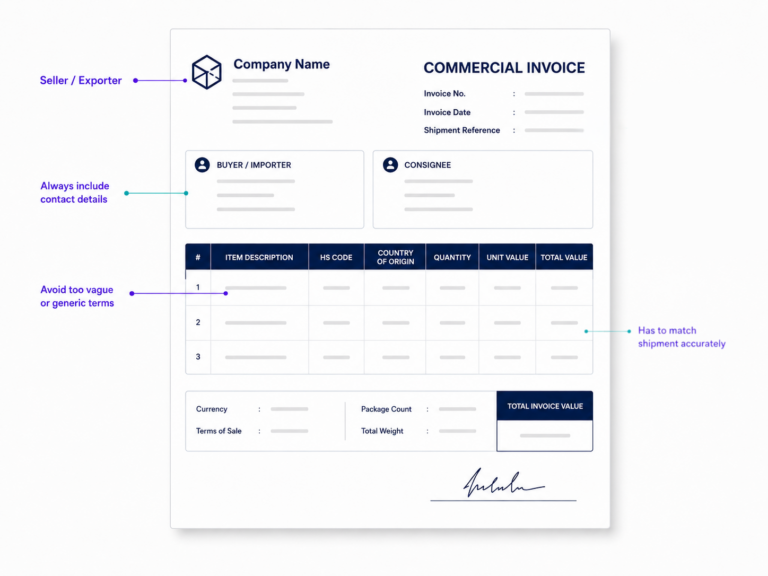
The commercial invoice is a core customs document. It is used in the import clearance process, and customs authorities use it to assess duties and taxes. An HS code can support faster clearance and help with duty and tax assessment.
Bill of lading
The bill of lading remains a key freight document because it governs the shipment between shipper and carrier. It is the legal contract for LTL or FTL freight. With Lazr, you can auto-generate carrier-specific BOLs within the platform.
Customs documentation
Depending on the shipment, customs documentation may also include origin-related support, trade-agreement documentation, and export reporting details. Many non-restricted commercial goods exported for consumption in the U.S. do not require a Canadian export declaration, but exceptions still apply, especially for restricted goods, in-transit movements, or other regulated cases.
Additional regulatory paperwork
Some products need more than standard freight paperwork. Some commodities may be subject to specific requirements from partner government agencies, and some goods may require permits, certificates, or licences. That is where generic cross-border checklists often fall short.
How businesses can avoid cross-border shipping errors
Standardizing shipping documentation
The fastest way to reduce preventable friction is standardization. Use one process for invoices, BOLs, shipment data, and supporting files. Better outcomes can be expected when teams stop rebuilding shipment documents manually for every order.
Improving shipment data accuracy
Cross-border shipping gets easier when core data is clean at the start: weight, dimensions, declared value, commodity description, origin, and service requirements. Our approach is based on accurate shipment details, to help minimize post-shipment adjustments and customs-related issues.
Working with logistics platforms
Disconnected portals create too many chances for inconsistency. Cross-border execution works best when rates, labels, tracking, and customs-supporting data live in one operating flow. That makes it easier to move faster while staying in control.
How Lazr helps facilitate cross-border shipping
Our platform helps teams generate shipping documents, structure shipment data, compare live carrier options, and connect workflows through API, ERP, WMS, OMS, and eCommerce integrations.
Result: Freight shipments orchestrated with no hassle.
Lazr also supports customs-document preparation, HS-code assistance, and duty-related calculations. While we do not make compliance decisions on behalf of shippers, we help surface requirements, standardize inputs, and reduce common errors so teams can move with better information.

Simplifying cross-border shipping operations with digital tools
Cross-border shipping becomes costly when the process is unclear. Wrong codes, weak documents, unclear responsibilities, and poor data create delays that are hard to unwind once freight is in motion.
At Lazr, we see the biggest gains when businesses treat cross-border shipping as a data and workflow problem, not just a carrier problem. Better structure upfront leads to fewer surprises at the border and more consistent execution on the other side.
FAQ
What are the most common mistakes in cross-border shipping?
The most common mistakes include incorrect HS classification, missing documentation, wrong declared value, and misunderstanding Incoterms.
Why are HS codes important when shipping to the U.S.?
HS codes determine duty rates, influence customs clearance, and impact how goods are reviewed at the border.
What happens if customs documentation is incorrect?
Incorrect documentation can lead to delays, additional inspections, penalties, or rejected shipments at the border.
Who pays duties when shipping from Canada to the U.S.?
It depends on the Incoterms used. The exporter or importer may be responsible depending on the agreed terms.
How can businesses reduce cross-border shipping risks?
By standardizing documentation, improving data accuracy, and using centralized systems to manage shipping workflows.
-

Green shipping: reduce shipping waste and costs without slowing fulfillment
By Rubi Rodriguez • September 4, 2026Green shipping depends on operational choices, not just packaging or marketing claims. Right-sized packaging, appropriate service levels, and shipment consolidation can reduce both costs and… -
What is a commercial invoice in shipping?
By Rubi Rodriguez • August 28, 2026A commercial invoice must clearly and accurately state the goods, value, parties involved, country of origin, and HS codes to avoid customs delays. Because requirements… -

Pallet shipping: prepare, quote, and move palletized freight without costly mistakes
By Rubi Rodriguez • August 21, 2026Most pallet shipping cost overruns come from inaccurate shipment data rather than the carrier rate itself. The best quote is the one that reflects complete…