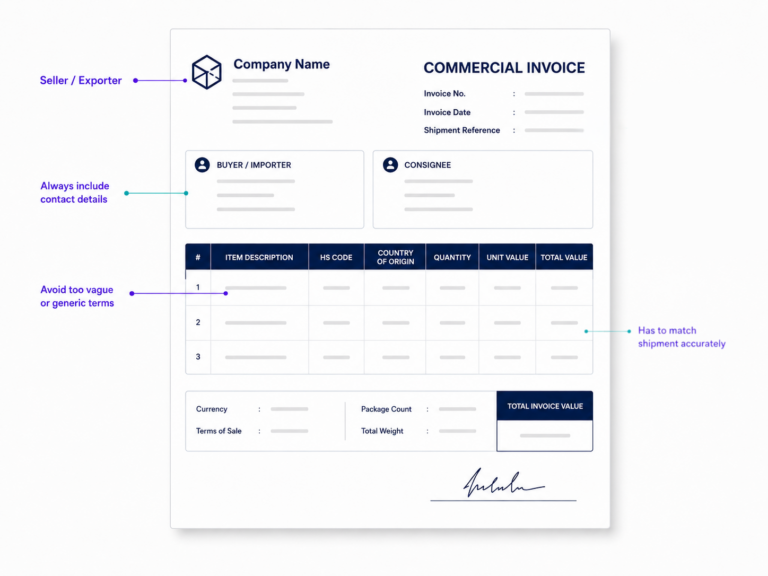
Less-than-truckload (LTL) shipping still runs on a single number: freight class. Get that number wrong and you risk re-class fees, billing disputes and delayed pickups. Below is a plain-language look at how the National Motor Freight Classification (NMFC) works today, what changed in the big 2025 overhaul, and how Lazr automates the hard parts.
Why freight class matters
Carriers quote and invoice LTL moves in hundred-weight (CWT) rates tied directly to freight class. A lower class (say 50) is denser, easier to load and cheaper per lb; a higher class (up to 500) is bulkier, fragile or high-risk and commands a premium. The NMFC historically used 18 classes, from 50 to 500 .
Getting the class right avoids:
surprise re-weighs and accessorials
charge-backs from 3PLs or end customers
carrier blacklisting for chronic mis-classing
The four classic factors
1. Density : weight ÷ cubic feet
2. Stowability : odd shapes or hazmat reduce stackability
3. Handling : fragility, need for side-door or lift-gate
4. Liability : theft risk or high value
2025: density takes the wheel
On 19 July 2025 the NMFTA replaced much of the commodity-based table with a 13-tier density scale, adding new Classes 50 and 55 for very dense freight . More than 2,000 commodities shifted to density rules, making mis-classing both easier and costlier .
Common pitfalls we still see
Listing nominal rather than packed dimensions
Forgetting pallet height in stackable freight
Using last year’s class after product redesign
Rounding density up or down “a little” to hit a nicer rate
How Lazr removes the guesswork
Automatic class calculation – Enter length, width, height, weight; Lazr returns the correct NMFC density class instantly.
Pricing Intelligence – compares that class across 100 + connected LTL carriers so you see the cheapest on-time option in one screen.
Real-time API/EDI tariffs – mean your quote already reflects the 2025 scale—no manual look-ups.
All shipment data – stays centralised for audits, so finance can trace every re-weigh or credit note in seconds.
How Lazr Supports Successful Cross-Border LTL Operations:
All docs in one place –Bills of Lading and shipping labels are generated within the platform, while documents such as CUSMA certificates and other supporting files can be uploaded to the order for easy access and visibility.
Pricing Intelligence – Compares API, EDI and paper tariffs to find the most cost-effective compliant carrier on every lane.
Shipment visibility & tracking – Manage all your shipments in a single TMS to monitor progress, support follow-ups, and maintain end-to-end traceability.
Trilingual human support – Work with a Canada-based operations team offering shipment support in English, French, and Spanish.
Key takeaways
Freight class still drives every LTL dollar, density matters more than ever.
The 2025 NMFC update created finer break-points; double-check your density math.
Automating class selection inside your TMS eliminates human error and costly re-classes.
Ship smarter with Lazr
Start a free account, calculate your next class in under a minute and lock in the best carrier rate today.
Rubi Rodriguez is an international logistics engineer at Lazr Freight.
With over 10 years of hands-on experience in fleet management, LTL/FTL transport, and cross-border operations, she turns logistics complexity into actionable insights for shippers.
Choosing between parcel courier services and Less-Than-Truckload (LTL) freight isn’t just a matter of weight limits, it affects cost, transit time and customer experience. Below is a plain-text roadmap to help you choose the right option, followed by an overview of how Lazr’s unified TMS supports both parcel and LTL workflows in one platform. Parcel:…
How to Succeed with Cross-Border LTL Shipments Summary Domestic LTL shipments already demand accuracy. Crossing the Canada–U.S. border raises the regulatory bar even further. This article outlines the key documentation and security checks required for cross-border LTL shipments, and explains how Lazr’s unified TMS helps streamline compliance workflows and documentation management, reducing delays, and operational…
If your business ships freight regularly but does not fill an entire trailer, LTL shipping in Canada is often the most practical option. LTL, or less than truckload shipping, lets multiple shippers share trailer space, so you only pay for the portion of capacity your freight actually uses. For many Canadian businesses, that means lower…
Digital freight relies on data centralization and workflow automation, with logistics performance now driven by the speed and quality of data processing. Real-time visibility is a baseline expectation, shifting differentiation toward execution where operational efficiency matters more than pricing alone.
Supply chain automation has become essential for managing complexity, costs, and performance. Its primary benefits come from eliminating manual tasks and centralizing data, while real-time visibility improves decision-making and reduces costly exceptions. In this context, the most effective starting point is to automate the most costly or error-prone process.
Data errors are the primary source of hidden costs in cross-border trade. Elements such as HS codes, declared value, and documentation directly impact both costs and lead times, while misunderstood Incoterms introduce liability risks and shipment delays. In this context, data standardization and quality remain the most effective levers to reduce errors.
Manage Consent
To provide the best experiences, we use technologies like cookies to store and/or access device information. Consenting to these technologies will allow us to process data such as browsing behavior or unique IDs on this site. Not consenting or withdrawing consent, may adversely affect certain features and functions.
Functional
Always active
The technical storage or access is strictly necessary for the legitimate purpose of enabling the use of a specific service explicitly requested by the subscriber or user, or for the sole purpose of carrying out the transmission of a communication over an electronic communications network.
Preferences
The technical storage or access is necessary for the legitimate purpose of storing preferences that are not requested by the subscriber or user.
Statistics
The technical storage or access that is used exclusively for statistical purposes.The technical storage or access that is used exclusively for anonymous statistical purposes. Without a subpoena, voluntary compliance on the part of your Internet Service Provider, or additional records from a third party, information stored or retrieved for this purpose alone cannot usually be used to identify you.
Marketing
The technical storage or access is required to create user profiles to send advertising, or to track the user on a website or across several websites for similar marketing purposes.