
Tariff vs. Duty: How each one affects your landed cost
By Rubi Rodriguez
Published on April 24, 2026
In short
A tariff is the rule or rate structure, while a duty is the actual charge applied to the shipment. Confusing the two leads to weak landed-cost estimates and avoidable compliance risk. Better cross-border decisions depend on validated classification, origin, valuation, and trade-agreement data.
In short
A tariff is the rule or rate structure, while a duty is the actual charge applied to the shipment. Confusing the two leads to weak landed-cost estimates and avoidable compliance risk. Better cross-border decisions depend on validated classification, origin, valuation, and trade-agreement data.
Teams often use the terms tariff & duty interchangeably, but they are not the same thing. Think of tariff vs. duty this way:
- Tariff is the rate schedule or rule that tells you what charge applies to a product
- Duty is the actual amount charged on the shipment.
Although teams often use the terms interchangeably, the difference between tariff and duty matters well before freight moves.
Blending tariff and duty together can lead a team to underestimate cross-border shipping costs and make weaker landed-cost decisions. The result is often inaccurate quotes, misleading sourcing comparisons, and compliance exposure that builds quietly in the background.
And once those errors reach the border, they are usually far more expensive to fix than they were to prevent.
The core distinction most teams get wrong
Most operations teams get into trouble because they use the words too loosely. A tariff helps determine the duty, but the duty is what hits your landed cost.
What is a duty?
A customs duty is the customs charge owed when goods are imported. In other words, duties are the broad category of taxes or charges collected on goods, usually at the border. They depend on the product’s classification, its origin, and the value declared under the destination country’s customs rules.
What is a tariff?
An import tariff is the rate structure or policy measure behind that charge. It can mean the tariff schedule itself, the preferential tariff treatment available under a trade agreement, or an additional policy layer, etc.
How to tell them apart?
Tariff is the rule set; duty is the bill produced when that rule set is applied to a real shipment. In other words, all tariffs are duties, but all duties are not tariffs, because tariffs are a specific type of duty.
Here’s a simple way to think about it:
- All tariffs are duties because a tariff is one type of customs duty.
- Not all duties are tariffs because there are other charges besides tariffs, such as:
- anti-dumping duties
- countervailing duties
- excise duties
- other import-related fees or assessments
Example: If a product enters a country, it might face:
- a normal tariff based on its classification, and
- an extra anti-dumping duty if the government thinks it was sold unfairly cheaply.
Both are duties, but only the first one is the tariff in the narrow sense.

Why it matters before you quote: the landed cost equation
How does understanding these nuances impact your landed cost? Before quoting a cross-border lane, teams need more than a product price and a freight rate. They need the customs data that drives landed cost accuracy. Miss one of these inputs, and the quote can look right while still being operationally wrong.
5 data points you need before quoting a cross-border lane
- Validated HS code, not an estimate. Customs classification drives tariff treatment, duty assessment, and sometimes admissibility. If the code is wrong, the cost model is wrong.
- Actual country of origin of the product. Origin affects preferential treatment under agreements such as CUSMA/USMCA and can also trigger additional measures.
- CIF value: Customs value input, often simplified operationally as CIF (cost + insurance + freight). In Canada, the formal concept is value for duty, and it must be determined under CBSA valuation rules.
- Active trade agreements. Preferential treatment is not static and only applies when the shipment actually qualifies and the proof of origin is in place.
- The destination country’s de minimis threshold and low-value program rules. These can materially change the cost outcome, and they do change over time.
How misclassification creates compliance exposure, not just cost overruns
Misclassification is not just a costing issue. It can also create serious cross-border compliance exposure through penalties, delays, or holds. False or incorrect declarations can also lead to detention or seizure, not only extra cost.
The bigger issue for operations teams is the compliance gap: the difference between what the team believes the shipment will cost and what customs is actually entitled to collect. That gap often comes from using an estimated HS code, relying on the supplier’s origin assumption, or claiming preferential treatment without valid support.

Tariff vs. duty in lane comparison: the real-world impact
This is where the tariff vs. duty confusion starts distorting sourcing decisions. A lower factory price does not automatically mean a lower landed cost. Two suppliers can quote the same SKU at similar freight cost, but if one origin qualifies for preferential treatment and the other attracts an extra tariff layer, the total landed cost can diverge fast.
A practical example: the same product shipped on the same lane may clear very differently, depending on origin. A qualifying North American product shipped from Canada to the US may receive preferential treatment under CUSMA/USMCA, while a China-origin version of the same product may face its base duty plus an added trade-remedy layer. That is exactly where teams misread a cheap purchase price as a cheap sourcing decision.
Incoterms make the cost allocation even more important. They define who manages and pays for transport, customs formalities, and related risks. In broad terms:
- DDP places duties and taxes on the shipper or seller
- DAP leaves import clearance and import charges to the buyer/importer
- EXW pushes most downstream transport and border responsibility onto the buyer from origin.
So even when the tariff and duty logic stay the same, the party absorbing that cost can change dramatically.
What compliance-ready teams do differently
Compliance-ready teams usually do three things better than everyone else.
- First, they separate the base duty rate from any extra tariff layer such as anti-dumping, or countervailing measures in their systems and reporting.
- Second, they calculate landed cost by lane, not just by SKU, because origin, destination, low-value rules, and Incoterms can all change the result.
- Third, they treat trade-agreement eligibility as a live variable, not a permanent assumption, because preferential treatment depends on valid origin support and current program rules.

How Lazr Supports More Accurate Cross-Border Shipping Decisions
Lazr fits this problem well because the issue is not just freight procurement. It is data quality. Lazr’s platform compares live rates from 100+ carriers, auto-generates labels and customs documents, and provides real-time shipment updates from one central workflow.
Our cross-border and API solutions also emphasize customs-readiness inputs such as Harmonized codes, country of origin, tax identifiers, USMCA/NAFTA documents, commercial invoices, and full landed-cost data.
For operations teams, that means better-structured shipment data, better preparation for cross-border moves, and better visibility into the real total cost of a lane before it becomes a customs problem.
If your team understands the tariff, predicts the duty, and validates the data behind both, you make better landed-cost decisions upstream instead of paying for surprises downstream.
FAQ
What is the difference between a tariff and a duty?
A tariff is the rate schedule or policy rule used to determine import charges. A duty is the actual customs amount charged on a shipment.
Why does tariff vs. duty matter in landed cost calculations?
Because landed cost depends on more than freight. Classification, origin, value, and applicable trade rules can significantly change the final import cost.
Can two identical products have different duty outcomes?
Yes. If the country of origin changes, the shipment may qualify for different tariff treatment or be subject to additional trade-remedy measures.
What data should be validated before quoting a cross-border shipment?
At minimum: the HS code, country of origin, customs value, trade-agreement eligibility, and destination-country low-value rules.
-

Accessorial charges in freight
By Rubi Rodriguez • September 11, 2026Accessorial charges fall into three buckets: predictable service needs, data-driven corrections, and execution-related events. Not all of them can be eliminated, but you can prevent… -

Green shipping
By Rubi Rodriguez • September 4, 2026Green shipping depends on operational choices, not just packaging or marketing claims. Right-sized packaging, appropriate service levels, and shipment consolidation can reduce both costs and… -
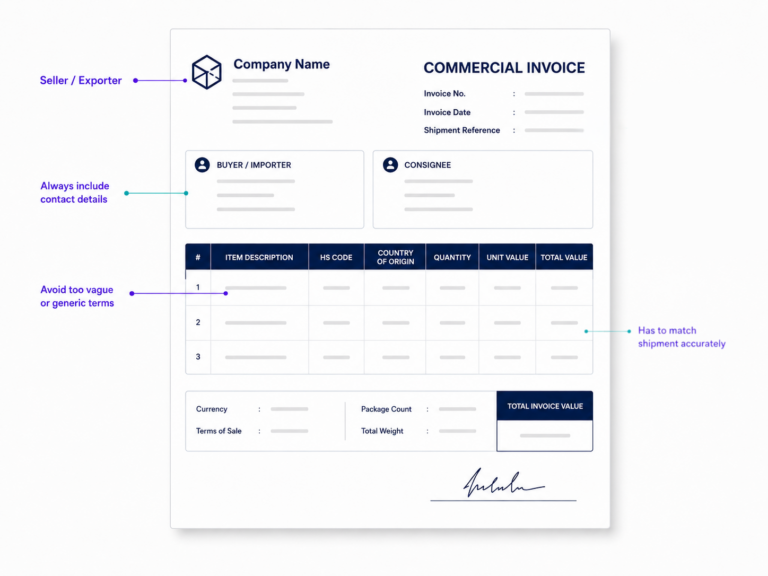
What is a commercial invoice in shipping?
By Rubi Rodriguez • August 28, 2026A commercial invoice must clearly and accurately state the goods, value, parties involved, country of origin, and HS codes to avoid customs delays. Because requirements…