
Parcel volumetric calculator
Easily find volumetric weight to avoid overpaying for bulky parcels. Our online tool helps you compare courier costs and ship smarter based on package size.
FAQ & Glossary
Blog
Volumetric Calculator
Getting started with LAZR
in less than 3 minutes.
1.
Enter your parcel dimensions.
Add the length, width, and height in your preferred unit (cm or inches).
2.
Select your courier
Choose your courier from the list or select Other if unknown.
3.
Click “Calculate”
Instantly see the volumetric weight in kilograms or pounds. Use the Reset button to start over.
What is volumetric weight ?
Volumetric weight, also known as dimensional weight, is a pricing method used by couriers and logistics companies to account for the space a parcel occupies during transport. Unlike physical (or actual) weight, which measures how heavy your shipment is, volumetric weight reflects how bulky it is.
For example, a large box filled with lightweight materials, like foam or clothing, takes up more space in a delivery truck or airplane than a small, heavy item. Because space is limited, couriers use volumetric weight to ensure shipping costs fairly reflect both the mass and volume of each package.
In short, understanding volumetric weight helps you avoid surprises on your shipping invoice and accurately predict delivery costs before booking your shipment.
The volumetric formula
To calculate volumetric weight, couriers use a standard formula that converts the parcel’s dimensions into an equivalent weight:
Why is it used by carriers?
Carriers use volumetric weight to ensure shipping prices remain fair and proportional to the space used in their vehicles or aircraft.
Volumetric weight
(Length × Width × Height) / Dim Divisor
Measurements can be in cm or in inches.
The divisor varies depending on the courier and type of transport (air, sea, or ground).
For example
If your parcel measures 10× 15 × 15 inches and the courier’s divisor is 139:
(10 × 15 × 15) / 139 = 35.69 lbs volumetric weight
If your package’s actual weight is less than 35.69 lbs, most couriers will use the volumetric figure to calculate your shipping rate.
You can easily test this yourself using our free Volumetric Weight Calculator above! It instantly computes your chargeable weight in kilograms or pounds based on your preferred units and courier.
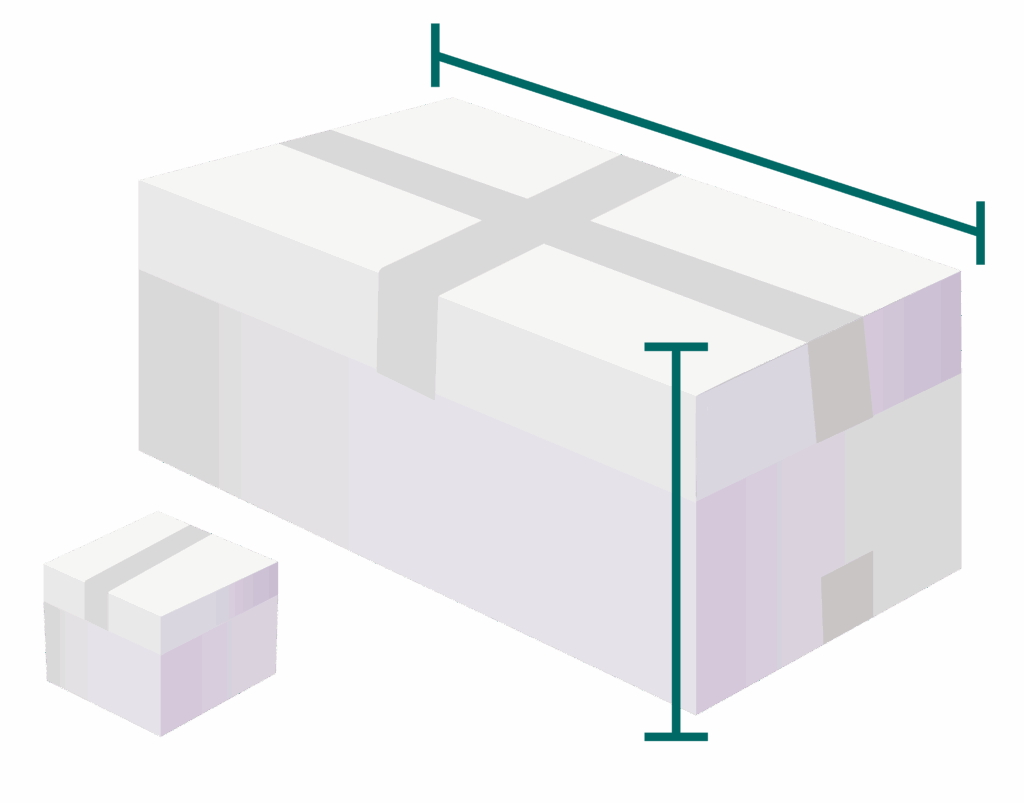
Imagine two boxes
If pricing were based on actual weight only, the first shipment would cost less even though it occupies far more space. Volumetric weight corrects that imbalance.
It also encourages efficient packaging, helping carriers transport more parcels per route and reduce emissions.
Total chargeable weight of a shipment :
Two methods
Method 1 : Shipment-based calculation
(used by FedEx and UPS)
The most common approach is to compare the total physical weight of all parcels in the shipment with the total volumetric weight of all parcels combined, and charge whichever is greater.
For example:
In this case, the chargeable weight would be 52.9 lb, since it exceeds the total physical weight.
Method 2 : Piece-based calculation
(used by DHL)
Some couriers calculate the chargeable weight per parcel, then add up each parcel’s individual chargeable weight to determine the total.
For example:
This method can result in a slightly higher overall charge for shipments with uneven parcel sizes, but it ensures each piece is priced proportionally to its space usage.
Expert’s tips to reduce
Chargeable weight
Choose snug packaging.
Avoid oversized boxes and reduce empty space; use fillers only when necessary.
Measure accurately.
Round up each dimension up to the nearest centimetre, carriers typically do the same.
Consolidate shipments.
One well-packed parcel often costs less than several small, half-empty boxes.
Compare couriers.
Divisors and pricing thresholds vary. Browse through our carriers to pick the most cost-effective option for your dimensions.
Separate value from weight.
For high-value, lightweight items, add protection with shipping insurance rather than over-padding the box.
You have questions?
We have answers!